Emissions idle: October Class 8 purchasing hits pause
Key Highlights
- North American Class 8 truck orders stalled in October as commercial fleets paused purchasing plans amid unresolved EPA 2027 emissions regulations and unfinalized equipment pricing.
- ACT reported preliminary October Class 8 net orders plummeted 45% year-over-year to 13,500 units, noting that regulatory ambiguity has left OEMs and carriers unable to finalize future planning.
- FTR recorded 15,600 Class 8 orders, emphasizing that fleets are delaying investments to evaluate the costs of nonconformance penalties against the expensive premiums of fully compliant engines.
- The sluggish start to the fall order season represents a sharp reversal from the aggressive spring pre-buy volume that completely consumed all remaining Model Year 2026 heavy-duty manufacturing capacity.
The North American Class 8 truck market hit a roadblock in October as fleets parked their purchasing plans amid unresolved federal emissions mandates.
Preliminary data from ACT Research and FTR Intel reveals a sharp drop in heavy-duty orders to start the traditional fall order season. After a spring fueled by frantic pre-buying and a summer of sold-out assembly lines, carriers are now grappling with unfinalized equipment pricing and a lack of regulatory clarity from Washington regarding Model Year 2027 compliance. That combination has restricted OEM build slot releases and fleet capital deployment, setting up a transitional period for the industry.
“While spot rates remain supportive of equipment demand, the lack of clarity around EPA 2027 rules and associated costs has left OEMs and fleets unable to plan for next year,” Carter Vieth, ACT research analyst, said in a release on October data.
October reports reveal steep pullback
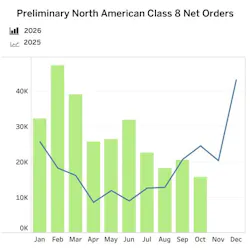
ACT reported preliminary North American Class 8 net orders dropped to 13,500 units in October, representing a 45% decline year-over-year. The seasonally adjusted figure fell to 10,600 units.
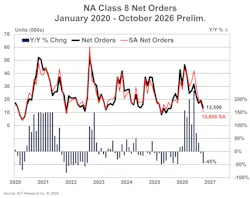
FTR tracked a similar contraction, logging 15,600 Class 8 orders, marking a 24% month-over-month decrease and a 36% drop year-over-year. FTR noted October’s totals fell nearly 50% below the 10-year October average of 31,089 units, creating a sluggish start to the 2027 order season. Combined September and October orders reached 36,002 units, down 20% compared to the same timeframe last year.
However, the medium-duty sector maintained its momentum.
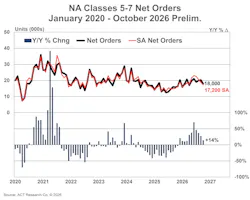
ACT reported preliminary Classes 5–7 net orders climbed 14% year-over-year to 18,000 units in October, continuing the segment’s steady recovery from soft volumes last year.
The heavy-duty hesitation stems directly from the EPA’s 2027 NOx regulations. FTR analysts stated that while truck manufacturers have opened MY 2027 order boards, many have delayed fully releasing build slots or finalizing pricing. Fleets are evaluating nonconformance penalties that could add an estimated $6,000 to $7,000 per engine, compared with an $8,000 to $12,000 premium for fully compliant engines.
Spring pre-buys sparks capacity scramble
October’s steep declines represent a jarring reversal from the aggressive purchasing environment that defined the spring. In May, Class 8 order intake surged as carriers rushed to secure surcharge-free MY 2026 build slots ahead of the EPA mandate. FTR recorded 26,600 net orders in May—a 124% year-over-year surge—marking four consecutive months of year-over-year growth exceeding 120%. ACT logged 26,500 units in May, representing a 103% year-over-year increase.
“The May result reinforces that demand remains healthy, supported by replacement needs, firming freight rates, rising utilization, tighter capacity, limited remaining 2026 build availability, and moderate EPA 2027 NOx pre-buy activity,” Dan Moyer, FTR senior analyst for commercial vehicles, said in May.
That momentum accelerated in June, when FTR reported Class 8 orders jumped to 30,500 units. That figure marked a 16% month-over-month increase and 241% gain year-over-year, registering as the second-largest June order total in FTR history. “The possibility that orders are already spilling over into Q1 slots in 2027 raises the stakes on the details of changes to the EPA 2027 NOx revisions,” Moyer said in June.
Summer volumes consume final 2026 slots
By July, the relentless order pace consumed remaining 2026 production schedules, shifting the market from an order-driven environment to a capacity-allocation phase.
July orders remained strong annually, but sequential month-over-month declines reflected physical manufacturing constraints. ACT recorded 22,100 units—up 68% year-over-year, but down 30% month-over-month seasonally adjusted. FTR logged 22,000 units, representing a 75% year-over-year gain but a 31% drop from June. “The sizable month-over-month decline doesn’t reflect a sudden drop in demand for new equipment but indicates a lack of 2026 build slots available as orders run up against full Class 8 backlogs,” Vieth said in July.
The market officially closed out the MY 2026 order season in August. ACT reported 16,800 units, noting that second-half 2026 backlogs exceeded production capacity by roughly 35,000 units. FTR posted 18,200 units.
“Overall, August marks the close of the 2026 order season and the effective end of the EPA 2027 NOx pre-buy,” Moyer said then. “September begins a new phase with MY 2027 ordering opening and fleet decisions increasingly shaped by engine choice, pricing, build timing, and the yet-to-be-finalized EPA 2027 NOx compliance framework.”
Autumn brings shifting seasonality
When the industry entered the fall season, the traditional kickoff for annual orderboard openings collided with the unresolved EPA parameters. September data produced a split picture: FTR logged 21,300 units, an 18% month-over-month increase and a 3% year-over-year bump. ACT recorded 18,700 units, a 9.5% year-over-year decline. Both research organizations agreed that delayed OEM order board openings disrupted historical order seasonality.
“The 2027 regulatory engine transition is clearly impacting order seasonality this year, but the underlying demand for new equipment remains robust, supported by strong spot rate momentum,” Vieth said in September.
Because truck and engine manufacturers deployed varying emissions strategies, fleets entered the fall without firm economic baselines for equipment acquisition. “Higher NCPs would narrow the cost advantage of current-generation engines while lower NCPs would make that pathway more attractive,” Moyer said at the time.
Class 8 order outlook
The six-month evolution of Class 8 ordering reveals a commercial fleet market driven by solid underlying economic fundamentals that is currently restrained by government policy. While October’s order volume contracted sharply, year-to-date orders still reached 278,201 units, a 74% increase over the previous year. Industry analysts expect equipment procurement to normalize once manufacturers finalize pricing and Washington clarifies its enforcement posture.
“Weak October results suggest that some purchases may be deferred rather than canceled, potentially allowing orders to strengthen as emissions requirements, production schedules, and equipment pricing become clearer,” Moyer said.
About the Author
 Jason McDaniel
Jason McDaniel, based in the Houston TX area, has more than 20 years of experience as an award-winning journalist. He spent 15 writing and editing for daily newspapers, including the Houston Chronicle, and began covering the commercial vehicle industry in 2018. He was named editor of Bulk Transporter and Refrigerated Transporter magazines in July 2020.