Truck orders surge: Exploding demand collides with tightening 2026 builds, EPA regulations
North American Class 8 truck orders rose to 30,500 units in June, up 16% from May—and 241% year-over-year, according to preliminary data from FTR Intel.
Prior-year comparisons have now exceeded 100% for five straight months, FTR reported. Orders were about 68% above the 10-year June average and represent the second-largest June net order total since FTR began tracking the metric. The sequential gain suggests demand momentum remains intact despite tightening 2026 build availability.
“The possibility that orders are already spilling over into Q1 slots in 2027 raises the stakes on the details of changes to the EPA 2027 NOx revisions,” Dan Moyer, FTR senior analyst for commercial vehicles, said in a news release. “The proposed revisions have been cleared by the White House and are expected to be published in early July. The industry’s understanding is that EPA will retain the 2027 start date and 0.035 g/hp-hr NOx limit but soften provisions related to warranty, useful life, and credit trading provisions.
“With 2026 demand exceeding build slots, an increasingly important question is EPA’s enforcement posture in the early months of the regulation. Key questions on the score are whether the proposed changes include non-conformance penalties (NCPs) and, especially, the size of those penalties and the duration of their availability if they are included.
“If NCPs were to cost materially less than the 2027 NOx hardware upcharge, OEMs could find it more feasible to slot excess demand into the first half of 2027.”
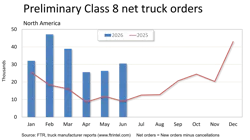
Year-to-date orders were up 125% y/y in June, and the 2026 order season (September 2025 to June 2026) cumulatively is running 36% ahead of last season, FTR added. At this pace, remaining 2026 build slots likely will fill up during the July order month, if they haven’t already, shifting the focus toward allocation, cancellation risk, and OEM build ramp execution.
Class 8 orders have totaled 334,160 units over the past 12 months.
Demand continues to be supported by replacement needs, firmer freight rates, tighter capacity/increasing utilization, limited remaining 2026 build slot availability, and some EPA 2027 NOx pull-forward. With remaining 2026 build slots likely to fill within weeks, the market is moving from an order-driven phase to a capacity-allocation phase. From here, policy developments—not underlying demand—are likely to become the bigger swing factor for fleet timing into 2027.
“USMCA also adds policy uncertainty going forward,” Moyer concluded. “For now, USMCA remains in place, which continues to limit the effective impact of Section 232 truck and parts tariffs. However, as of July 1, any of the three countries can withdraw with six months’ notice. The risk is that prolonged uncertainty or future changes could expose more North American content to higher costs.
“Overall, June orders confirm that the Class 8 cycle remains constructive, as monthly intake continues to surprise to the upside. The bigger question now is not demand but how much of the 2026 backlog converts to production before uncertainty over EPA, tariffs, and USMCA reshapes fleet timing for 2027.”