NTTC’s confined-space entry playbook combats complacency
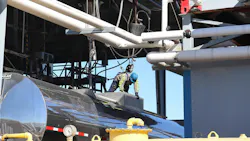
A single second of complacency inside a cargo tank can cost a life. That’s why National Tank Truck Carriers recently gave safety leaders a new blueprint for stopping fatal shortcuts before they happen.
During the Tank Wash and Maintenance Council meeting at Tank Truck Week 2026 in Oklahoma City, Sentry Road CEO Jim Tormey introduced the Confined Space Entry Best Practices Playbook—a 36-page manual and accompanying shop-floor toolkit built over the past year by the council’s Confined Space Entry Subcommittee. Rather than rehashing regulatory minimums, the group distilled hard-won field lessons to target the daily realities of wash racks and maintenance bays, where routine tasks can mask lethal atmospheric hazards.
“We left Tank Truck Week a year ago with the goal of providing tangible assets people could take back to their facilities to make them safer,” Tormey told attendees.
“I hope it’s valuable to you and your team.”

Confronting the “complacency” trap
Bureau of Labor Statistics data cited in the playbook underscores why tank entry remains one of the industry’s highest-risk tasks: confined space incidents claim 100 to 130 U.S. workers each year—roughly two per week—at an average cost of $1.6 million per fatality. Yet 85% of those deaths are preventable with proper training, and facilities that fully comply with OSHA’s Permit-Required Confined Space standard (29 CFR 1910.146) cut their incident rates by 42%.
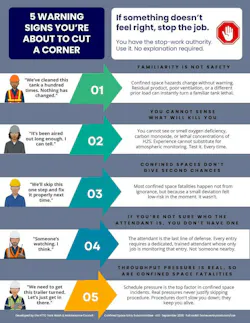
When committee members examined root causes, one word surfaced repeatedly.
“It’s just complacency,” Tormey said. “They’ve done it 100,000 times—so it’s very easy to take a shortcut.”
To break that “normalization of deviance,” the playbook dissects common operational failure points—such as “pencil-whipping” permits under throughput pressure, trusting uncalibrated gas monitors, or blurring the lines between entrants, attendants, and supervisors—and pairs them with field-tested fixes. It also strips away corporate polish to present anonymized near-miss case studies. One recounts an 18-year-old worker who collapsed inside an unventilated, unpermitted trailer; another details a dozing driver who began pulling out of a wash bay while a cleaner was still inside the tank.
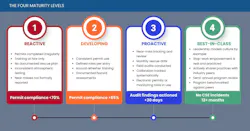
Beyond baseline procedures, the guide pushes carriers toward monthly rescue drills, pre-entry walkthroughs with local fire departments, and emerging technologies—from wearable personal monitors to entry-free cleaning systems—that keep technicians out of tanks. At the back of the manual, a self-assessment matrix challenges managers to grade their shop-floor execution—not just written policies—on a scale that ranges from “Reactive” to “Best-in-Class.”
Translating strategy to the wash bay
While the 36-page playbook speaks to safety directors and operations managers, the committee recognized that frontline workers need immediate, visual reminders rather than dense policy manuals. So, alongside the main guide, they developed a suite of printable shop-floor resources. Available supplemental materials include an atmospheric testing quick-reference chart, a “5 Warning Signs You’re About to Cut a Corner” poster, a six-principle training guide, a program maturity self-assessment worksheet, and full-size and wallet-sized role cards defining exact “dos and don’ts” for entrants, attendants, and supervisors.
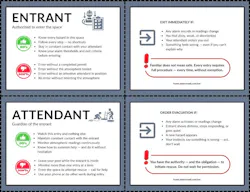
“We quickly realized people who are actually getting into the tanks, who are working in these shops, are never going to read this 36-page document,” Tormey noted. “It’s a different target audience. So we wanted to create things that were more usable and user-friendly within shops.”
Doug Vineyard, Highway Transport’s managing director of equipment services and the council’s chairman, echoed Tormey’s urgency, saying confined space entries keeps him awake at night. “When you run wash racks and shops, that’s your biggest fear—and we all have to deal with it,” Vineyard told the room. “How we keep people safe is not a trade secret.”
Member access and continuous evolution
The playbook and its companion resources are only available to NTTC members.
Carriers can download the kit through Sentry Road’s online portal or request the files from Tormey. NTTC also plans to host the documents on tanktruck.org. Additionally, Sentry Road will provide its updated, video-driven confined space entry training module to NTTC member organizations at no cost.
Tormey said the playbook is a “living document” designed to evolve as carriers submit new near-miss lessons and technology advances. He also urged safety leaders to put the resources to work immediately. “There’s a lot at risk here,” he said. “Obviously, this is a dangerous procedure. So we’re asking a lot of team members who are entering these tanks, and it’s important for all of us to set them up for success every time they go in.”

About the Author
 Jason McDaniel
Jason McDaniel, based in the Houston TX area, has more than 20 years of experience as an award-winning journalist. He spent 15 writing and editing for daily newspapers, including the Houston Chronicle, and began covering the commercial vehicle industry in 2018. He was named editor of Bulk Transporter and Refrigerated Transporter magazines in July 2020.
Related
 Img 1128