Pressure points: Protecting assets across the ISO tank chain
Key Highlights
- ITCA’s revamped Nov. 12 expo paired live hardware with lifecycle training for carriers, depots, and cleaners as global ISO tank volume nears 1 million units.
- Nouryon’s Josh Walton noted that protecting 316L stainless barrels requires descaling weld heat tint before chemical passivation removes free iron to restore the oxide shield.
- Mitchell Industries’ Rene Garces warned that interior linings fail mainly from poor application, urging owners to enforce inspection hold points, surface checks, and cure packets.
- Need4Peet’s Peter Hordijk outlined how ISO 9001:2026 elevates culture over compliance by demanding visible executive backing, verified worker competence, and disciplined communication across supply-chain handoffs.
- Atlas Technology’s Jessica Whitehouse and Chris Jaffe showed how clean records power AI tools that bridge intermodal blind spots, forecast dwell, and increase container turns.
PASADENA, Texas—The global tank container fleet continues to expand. Even as the chemical industry faced significant challenges in the last two years, especially in Europe, the worldwide count increased for the 35th consecutive year and swelled to nearly 900,000 units in 2025, according to the International Tank Container Organization’s 2026 fleet survey.
Steve Benet doesn’t see that trend reversing course.
“We’ll surpass 1 million ISO tanks operating globally this year,” predicted Benet, the Tank Service Academy’s event coordinator. “That number has increased substantially year after year, and it will continue to grow. Our world is getting smaller. We have specialty chemicals manufactured in the United States, and we have a very good export situation here right now with these chemicals going overseas. But we’re still dependent on commodity chemicals coming in.
“So this cycle will not stop. It will only continue to grow.”
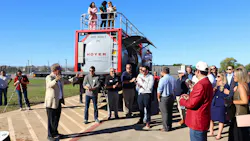
To help domestic stakeholders keep pace, the Intermodal Tank Container Association zeroed in on tank container selection, preparation, safe handling, and smart management during its revamped ITCA Expo at San Jacinto College’s LyondellBasell Center for Petrochemical, Energy, and Technology (CPET), where about 100 professionals representing ISO tank shippers, lessors, operators, and bulk fleets gathered Nov. 12 for social networking, educational sessions, equipment exhibits, and a tank-implosion demonstration.
Editor’s note: In the below video from the ITCA Expo, Steve Benet uses cold water to implode a sealed, steam-heated 30-gallon drum in under 30 seconds—recreating how 14.5 psi of atmospheric pressure crushes full-scale ISO tanks built without a $15 pressure relief valve.
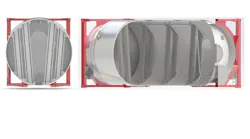
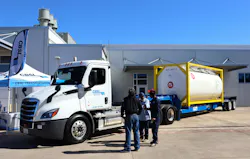
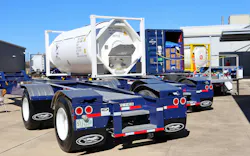
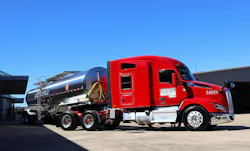
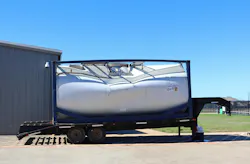
Moving away from its traditional Kemah, Texas, symposium format, which frequently leaned into shipper and chemical manufacturer concerns, ITCA partnered with CPET to place carriers, depots, and service providers front and center, delivering expert presentations alongside hands-on hardware displays and vendor booths outside the classroom. Hoyer showcased its new U.S. training tank, and CBSL Transportation Services staged a T11 ISO on a drop-frame chassis that lowers the tank’s top profile to match a conventional tank trailer.
“We’re staying busy, and capacity is tightening on the driver side for sure,” Tara Moore, CBSL vice president, told Bulk Transporter. “But at these types of events, it’s not so much about recruiting drivers as getting the word out about the challenges that are facing our industry.
“It’s important for everyone to understand this market.”
Inside CPET’s training room, briefings followed the operational lifecycle of an ISO tank move, from preparing 316L stainless steel through pickling and passivation, to specifying and inspecting interior protective linings, enforcing supply-chain quality control under ISO 9001:2026, and deploying AI that transforms fragmented tracking data into usable fleet capacity.
“One thing we need to understand is that a tank movement is a chain of assistance involving shippers, tanker operators, depots, cleaning stations, surveyors, road and rail carriers, terminals, freight forwarders, and ocean carriers,” said Peter Hordijk, lead consultant at Need4Peet.
“You name it—everybody is involved.”
Passivation builds the shield
Protecting that chain starts with the steel barrel itself.
Kicking off the classroom sessions, Nouryon Global Fleet Asset Manager Josh Walton noted that corrosion drains $2.5 trillion annually across global industries—roughly 3.4% of global GDP—though proven corrosion-control practices can save $375 billion to $875 billion a year.
“Stainless doesn’t mean it can’t stain—it just doesn’t rust,” Walton told attendees.
Low-carbon austenitic 316L stainless relies on chromium to form a continuous, self-healing passive oxide film just 1 to 5 nanometers thick, paired with nickel and molybdenum to resist chloride attack far better than 304 grades. Even so, surface condition matters as much as alloy selection. Echoing ASTM A380 and ASTM A967/A967M standards, Walton drew a sharp boundary between natural passivation, pickling, and chemical passivation. Welding or hot work above 700 degrees Fahrenheit creates straw, blue-purple, or black heat tint and chromium-depleted oxide scale, leaving internal welds, nozzles, and manways vulnerable to pitting.
“If heat tint or oxide scale remains, passivation alone is not the corrective treatment,” Walton emphasized.
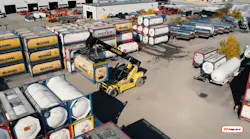

Instead, condition-dependent pickling—through acid descaling, electrochemical weld cleaning, or mechanical polishing—strips away weld oxides before chemical passivation removes the “free iron” left behind by shop tools and abrasive grinding. Left untreated, this triggers staining and breaches the passive layer, opening the door to chloride pitting and subsurface cavities.
To restore the protective barrier, Walton outlined a five-step workflow that includes cleaning the barrel with detergent, solvent, or high-pressure water; descaling heat tint where needed; passivating chemically—typically with 20%-25% nitric acid at 120-140 degrees F or 4%-10% citric acid at 120-150 degrees F for 20-60 minutes; rinsing with low-chloride water below 50 ppm and drying with heated air or a nitrogen purge; and verifying the re-formed film through visual inspection, optional testing, and complete documentation.
He also cautioned against treating a safety data sheet’s “non-corrosive” listing as a blank check, saying regulatory criteria still allow measurable annual pitting unless true cargo compatibility is verified.
“Chemical treatment cannot compensate for unsuitable cargo selection, damaged steel, or inadequate cleaning,” Walton concluded.
Linings fail when prep work slips
When 316L cannot withstand aggressive acids or ultra-pure payloads—such as the chemicals feeding North America’s booming semiconductor sector—interior linings serve as a dual barrier, keeping cargoes like hydrochloric acid, chloride solutions, and sodium hypochlorite off the steel while keeping trace metals out of sensitive products, explained Rene Garces, Mitchell Industries operations manager and an AMPP-certified coating inspector.
He stressed a lining is never a repair—and the six major tank lining families aren’t interchangeable: high-performance thermoset polymers led by ChemLINE 784, which accounts for roughly 80% of lined ISOs; baked-on phenolics, including Plasite 3070 and Sakaphen Si14E; epoxy novolacs and vinyl esters for bleach service; fluoropolymers such as PTFE for specialty chemicals; polyolefins; and rubber or metallic linings like thermal-sprayed zinc.
“It has to start with the SDS,” Garces said, pointing to chemical composition, concentration shifts, temperature extremes, and loading pressures. Because safety data sheets often omit proprietary blends and trace constituents, compatibility charts serve only as screening tools, passed 30- to 90-day immersion coupons do not prove multi-year service life, and compatibility letters are not blanket warranties—making written acceptance essential.
Even top-tier chemistry fails when applied poorly, he stated, showing photos of delamination, blistering, and vapor-space attack. “A lot of liners get a bad name because of the application,” he said.
“The liner works. It’s just applied wrong.”
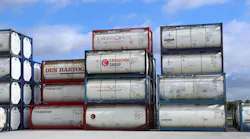
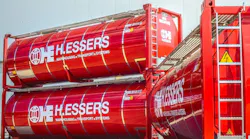
Proper execution requires following an Inspection and Test Plan (ITP) built around strict hold points, Garces maintained. Before spraying, shops must pre-clean tanks so blasting doesn’t drive contaminants into the steel; verify anchor profiles; and test for hydrocarbons, dust, and salts. They also must track humidity and steel temperatures and blotter-test compressed air for oil and moisture.
Because dry-film thickness (DFT) alone can’t detect under-cured coatings, Garces told operators spending $30,000 on a liner to demand quality packets with mapped DFT readings, high-voltage holiday spark testing, married pull-off adhesion coupons, calibration logs, and thermocouple cure charts such as 300 degrees F for six hours on ChemLINE 784. He recommended annual internal inspections, weighing total downtime over the quote price when patching thermosets versus relining phenolics, and conducting a photo-documented “Last Man Out” check after refitting valves and manlids to catch gouges or forgotten tools.
Above all, he urged owners to verify documented hold points, cures, post-assembly inspections, and complete records before accepting a vessel—and to vet shops carefully. “If your applicator doesn’t know what an ITP is, walk away,” Garces warned. “They’re not your guy.”
Standard update elevates culture over compliance
Clean steel and intact linings still depend on accurate information across the multi-party handoffs Hordijk mapped out.
Addressing quality control efforts following the Sept. 16 publication of ISO 9001:2026, Hordijk framed the update as an evolution that carries a three-year transition window and avoids a document-renumbering exercise. Instead, the revision sharpens expectations around visible leadership commitment, ethical reporting culture, verified worker competence, and evidence-backed risk management. In every handoff, stale booking templates or incomplete specs can go unchecked until a load is rejected. As Hordijk noted, a correct document cannot rescue an unsuitable tank, and a suitable tank cannot rescue incorrect information.
“Leadership’s involvement cannot be demonstrated only by a signed policy,” Hordijk underscored, explaining that under Clause 5, auditors look past framed statements to see how executives act when a tank is unfit, data is missing, or commercial teams pressure operations to ship. Passing that test requires funding preventive maintenance, empowering technicians to halt nonconforming releases, and keeping transparent records without backdating inspections.
Under Clause 7, training logs no longer prove competence without verification that confirms workers can perform a task, understand why it matters, and know when to stop. When urgent bookings clash with customer specs, Hordijk warned against defaulting to habit: “One thing I hear sometimes when I do consulting work is, ‘We’ve always done it this way.’ That’s dangerous.” Teams must stop, verify current approvals, and fix system gaps while replacing static risk registers with measurable actions tied to repeat rejections, cleaning failures, and supplier drift.
To prepare, Hordijk outlined a 90-day transition plan that includes obtaining the published standard and mapping high-risk handoffs, auditing shop-floor practices through frontline worker interviews, and delivering role-based training before aligning certification steps with a registrar.
“The culture is set under pressure—not during a presentation,” he said.

Intelligent operations turn data into capacity
Closing out the expo’s classroom agenda, Atlas Technology Vice President Jessica Whitehouse and Atlas President and CTO Chris Jaffe—who also serves as senior VP of technology at Agmark Logistics—showed how practical AI tools are reshaping tank management.
With ITCO reporting global fleet growth cooled from 3.96% in 2024 to 1.92% in 2025, Whitehouse said operators must generate more turns per tank, cut idle days, and eliminate manual work—while addressing frontline AI skepticism. “The goal isn’t to replace the people who know the industry,” she said. “It’s to put tools in their hands that allow them to do the job better.”
A single intermodal rail move crosses seven handoffs—from booking and drayage to rail linehaul, delivery, and washout repositioning—creating blind spots when milestones sit in disconnected systems. “Visibility is going to tell you where a tank is,” Whitehouse explained.
“Intelligence tells you what needs attention.”
To bridge the gaps, she outlined a four-layer stack that connects partner feeds, unifies every mode and cleaning status on one timeline, automates routine tasks, and supports faster decisions through shared dashboards. AI models can calculate predictive ETAs from historical dwell, flag extended terminal delays, capture BOL and wash-certificate data without retyping, and let staff query systems in plain language—starting small by automating one task at a time.
Jaffe said Agmark began deploying AI several years ago across six areas: document, dispatch, and business intelligence, alongside data analytics, forecasting, and dynamic pricing. Still, he cautioned, automation depends on clean records. “What it really boils down to is the data,” he said. “If you don’t have that underlying data, you’re not going to get good results.”
For Whitehouse, the competitive takeaway is unmistakable.
“The opportunity is here and it keeps growing,” she said. “If you don’t get ahead of it—you’re going to get left behind.”
About the Author
 Jason McDaniel
Jason McDaniel, based in the Houston TX area, has more than 20 years of experience as an award-winning journalist. He spent 15 writing and editing for daily newspapers, including the Houston Chronicle, and began covering the commercial vehicle industry in 2018. He was named editor of Bulk Transporter and Refrigerated Transporter magazines in July 2020.