Total tank care: Hoyer’s US cotac campus is a ‘one-stop shop’ for bulk logistics
Key Highlights
- The $15 million renovation includes modernized cleaning facilities, expanded storage, and upgraded safety and security features at Hoyer's cotac depot in Pasadena, Texas.
- Cotac USA employs highly trained staff and advanced automation to deliver over 10,000 product cleans annually, emphasizing safety and quality.
- The facility offers comprehensive services, including tank repairs, testing, modifications, and flexitank logistics, serving as a one-stop shop for customers.
- Strategic investments are driven by market shifts such as tariffs, nearshoring to Mexico, and increased domestic ISO tank adoption, positioning Hoyer for future growth.
- Safety remains a top priority, with rigorous protocols, innovative software, and advanced OCR systems to ensure operational excellence and compliance.
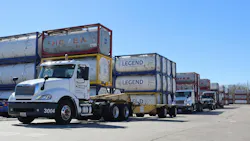
PASADENA, Texas—Hoyer has provided complete tank care solutions to North American customers from its Houston-area headquarters—which is the global bulk logistics company’s only U.S. location—for more than 30 years. But it enhanced those offerings in late 2024 with an ambitious $15 million renovation of its cotac operation in Pasadena, Texas, which now features modernized tank cleaning facilities, expanded steam heating capacity, storage for loaded ISO tanks, and other upgraded features. And the timing was terrific.
The diversification initiative not only boosted efficiency and “one-stop-shop” customer service, allowing Hoyer and cotac to weather last year’s tariff-fueled slowdown in chemical production, it positioned the group to take advantage of the long-delayed freight upswing that surely must be coming. “We definitely saw hesitation among shippers due to the uncertainty around the tariffs, and not really understanding what was coming next,” said Christian Berlin, Hoyer group executive director of operations. “So, we did see a reduction in the volume of imports coming through, and corresponding need for tanks. But we’re starting to see a shift, and there are some positive signs in the news, regarding tariffs and the economy.
Editor’s Note: For an inside look at the technology and operations in this article, visit our expanded media gallery. This collection highlights the 30-acre cotac site’s 12-bay wash rack, 18-in.-thick concrete for stacking up 800 loaded ISO tanks, and comprehensive maintenance services.
“So, we’re looking for a bounceback in the second half of the year, but it’s hard to say because there’s still so much uncertainty.”
That is true. But there’s no doubt that tariffs already are forcing some petrochemical manufacturers to rethink sourcing, and Mexico is a popular “nearshoring” destination. That development, combined with Hoyer leaders’ certainty that North America is primed for further domestic ISO tank adoption, prompted the group to bolster their Mexico City operation last year. And it’s why the emergence of a uniquely positioned, world-class depot with state-of-the-art tank container and trailer cleaning capabilities and capacity is so well-timed.
“The product we put out is spectacular,” said Jesse Gomez, cotac USA manager.
“We have highly trained, experienced employees who don’t leave, and they care about what they do; and we use premium cleaning products and technology. That’s why we don’t have rejections. One fleet customer we helped grow stopped by in January, and he said he’d recently visited three other sites, and our equipment looked better than anything else he saw.
“That’s what we do for carrier tenants, that’s what we do for Hoyer—and that’s what we do for everybody who comes through our door.”
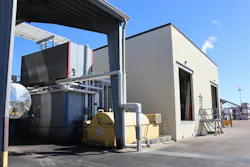
Safety-focused service
Walter Hoyer founded Hoyer in 1946 in Hamburg, Germany, and the global company remains family-owned today. The group of companies now includes over 4,000 employees operating in over 100 countries, and a lease fleet with more than 40,000 ISO tanks and 60,000 intermediate bulk containers (IBCs). Hoyer subsidiary cotac—short for complete tank care—maintains 12 locations: eight in Europe, three in Asia, and one in Texas, where it officially arrived eight years ago after Hoyer purchased Custom Containers of America’s on-site facility.
Hoyer today employs more than 200 people split between cotac’s container depot on Chemical Road and its USA headquarters situated 7 miles south on the aptly named Space Park Drive.
“We started as a family-owned company, and we’ve kept that feeling as we’ve grown internationally,” Berlin said.
Their approach includes a steady focus on safety and service, and cotac’s 30-acre Houston-area location—in the heart of the Gulf Coast chemical sector—is the synergistic center for all of Hoyer’s bulk logistics activities in North America. The original 15 acres boasts 50 employees, the 25-truck Hoyer Bulk fleet—a joint venture with Dupré Logistics formed in 2020—a depot with the capacity to hold up to 2,000 containers, a cleaning facility, and a maintenance and repair shop. The other half features several bulk-carrier tenants, with their own leased facilities and easy access to cotac’s services, and plenty of tank trailer parking.
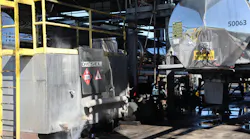
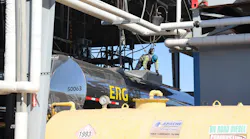
When Bulk Transporter visited in February, the depot housed 100 loaded and 800 empty tanks in service of petrochemical shippers—and cotac leaders were searching for the ideal new tenant to fill a recent opening. “We’re prime real estate for these companies,” Gomez explained. “We’ve had customers who stayed here for 10-15 years, and then grew so much, they eventually wanted to strengthen their brand, so they went out and built their own facilities.”
The 2024 overhaul, which Hoyer celebrated in a grand opening that included an appearance by Thomas Hoyer, Hoyer advisory board chairman and Walter’s 75-year-old son, added 9 acres of concrete—including 18-in.-thick pads that can store up to 800 loaded ISO tanks stacked five high—a fourth reach stacker for loaded ISOs, a new pump room for the wash rack upgraded by A-One Chemicals and Equipment, flexitank parts and service, an 18-lane steam heating station, an inspection rack, and new security lighting, fencing, and cameras.
Upgrades are ongoing, too. Cotac recently introduced “Safety Culture” software that includes a QR code for employees to report concerns and ordered an optical character recognition (OCR) camera system that digitally documents external equipment conditions at the new inspection rack.
Leaders expect to begin using the advanced OCR gate this summer.
“Our site management team takes great pride in our safety culture and the facility’s safety record,” said Coby Brown, cotac safety, health, environment, and quality manager.

One-pass cleaning
No one takes safety more seriously than Chuck Hargraves, cotac wash department manager, who’s worked at the site for more than 30 years. His no-nonsense safety program includes three-man confined-space entry teams equipped with meters, full-face respirators, and self-retracting harnesses; weekly toolbox meetings; and strict rules on what products they will and won’t clean, notably isocyanates and other extremely hazardous substances. All freshly cleaned tanks are left open for ventilation, and all hoses are left uncapped.
“Safety is our first priority,” Hargraves emphasized. “The second is delivering on our customers’ needs. So, when someone drops off an ISO tank or trailer, it’s clean, dry, and odor free by the next day, at the latest.
“That turn time is why our customers keep coming back.”
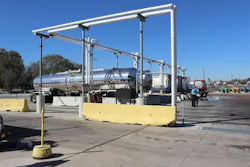
With A-One’s highly automated system, installed in eight of the facility’s 12 existing bays, cotac’s 10 cleaning technicians can handle over 10,000 products and turn out 65 tanks per day on one shift, Hargraves said. He worked with Marlin Moser, A-One general manager, to customize the two-part setup, which can wash up to 10 tankers or 12 of Hoyer’s 6,800-gallon ISO tanks at a time using recirculated diesel or single-pass doses of potable water and detergent that prevent caustic buildup. Each bay features a dedicated pump that delivers 42 gallons of water per minute (gpm) at 1,000 pounds per square inch (psi) to high-pressure spinners.
“The cotac team’s experience using one-pass systems informed the final product’s design,” Moser said. “Chuck and Jesse knew what did and didn’t work from their experience with this type of system, so we used their knowledge and experience to aid in the engineering. They wanted an automated system that allowed them to standardize cleaning processes without it being overly complicated or hard to maintain. And they wanted a vendor that would build what they wanted—so that’s what we did. Cotac also liked the idea of utilizing readily available parts, so long-term maintenance was incorporated into the system’s design.”
Further features include on-demand heating powered by two Miura boilers; two separate pre-solve systems that allow operators to presoak tank interiors with diesel, degreasers, or solvents; four adjustable wash programs, and four 8-gpm hot/cold water pressure washers that operate at 2,500 psi. A-One designed and installed the equipment in the newly constructed boiler room and the eight bays, and pre-plumbed the remaining bays, in less than one year—without any disruptions.
“A-One crews are experienced in working safely within existing infrastructure while tanks are being cleaned in nearby bays that can still be operated safely,” Moser said. “As a result, cotac was able to conduct normal operations while the new system was installed and tested.”
Distinguished depot operations
Clean ISOs don’t go directly back into service, Hargraves emphasized. Instead, the tanks are diverted to cotac’s 17-bay maintenance facility, where they receive new internal o-rings and dome-lid gaskets and undergo full-function testing, including a 20-psi leak test. “That’s another service that is unique to cotac,” Hargraves said. “And we treat our trailer customers just as well.”
Cotac’s R-stamp shop provides interior tank container and trailer repairs, as well as coating, frame, and insulation repairs; re-linings; external repairs to equipment and fittings, IBC repair, and routine maintenance services. Testing services include 2.5- and five-year periodic checks, pressures tests, and vacuum tests. And extensive modification services include technical upgrades such as top and bottom discharge alterations for oilfield customers, handrail and walkway installations, overfill prevention and grounding verification upfits, and more.
“We see our customers as partners, so we work with them, and we try to help them however possible,” Gomez said.
“The goal is for us to grow together.”
That’s why cotac continues to expand its comprehensive tank services, like offering flexitank logistics, a cost-effective ISO alternative that includes cardboard fitting of box containers, multiple bag sizes, bulk head systems and valve assembly, and heater pads for temperature-sensitive liquids. And all these offerings are attached to a depot that’s optimized for maximum throughput today—and the unrestricted growth of domestic ISO tank adoption tomorrow.
“Not all depots are created equally,” Gomez concluded.
“We can do everything right here. It’s a one-stop shop. So, customers save time and money, and they know exactly what they’re getting from a quality standpoint.”
About the Author
 Jason McDaniel
Jason McDaniel
Jason McDaniel, based in the Houston TX area, has more than 20 years of experience as an award-winning journalist. He spent 15 writing and editing for daily newspapers, including the Houston Chronicle, and began covering the commercial vehicle industry in 2018. He was named editor of Bulk Transporter and Refrigerated Transporter magazines in July 2020.