Smarter suction: AutoLoad upgrades dry bulk transport
Key Highlights
- David Sisk's early experience as a mechanic shaped BTI's innovative approach to tanker equipment design.
- The AutoLoad System is the industry’s first fully automated vacuum system for dry bulk transfer, introduced in 2022 and now widely adopted.
- AutoLoad features AutoClean and AutoWeigh, reducing maintenance costs, waste, and operational time while improving safety and compliance.
- Early adopters report significant time savings, with some operations reducing unloading times from hours to under two hours.
- BTI offers flexible installation options, including OEM partnerships and training, to expand AutoLoad’s reach across the industry.
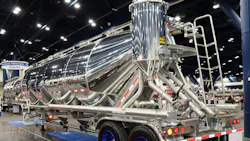
Bulk Tank Inc. (BTI) CEO David Sisk started his career in the tank trailer industry as a mechanic working on Schwerman Trucking’s pneumatic dry bulkers in 1970. And that early experience informed every innovation to which Sisk—whose name is associated with dozens of tanker equipment patents—contributed over the last 56 years, from Easy-Open hopper tees and Never-Seize manhole adjusters to BTI’s signature BlackMaxx composite fiber butterfly valves.
“We’re always listening,” Sisk said. “You’ve got to listen to the people in this industry, especially the drivers and mechanics. They’re the ones out there doing it, climbing under trailers, fixing this, fiddling with that, so they understand the problems, and we just want to make their lives easier.
“When you can fix the maintenance issues, everybody wins.”
That’s why Sisk is so excited about the BTI team’s latest solution—the “revolutionary” AutoLoad System. Introduced in 2022, the industry’s first fully automated vacuum system for safely and efficiently moving dry bulk products between tank trailers, tank cars, and storage silos is now in use by leading tank truck carriers across the country—with 150 units in the field. “This product is head-and-shoulders better than anything else I ever worked on,” Sisk insisted.
“It’s going to transform the dry bulk supply chain worldwide.”
Early adopters agree. Ee-Jay Motor Transports, which helped BTI finetune the “game-changing” system, raves about AutoLoad’s time-saving, environmentally friendly simplicity; and J&M Tank Lines’ Bulk Specialties Inc. shop subsidiary now is a certified installer of the complete, easily maintained system, which includes AutoClean and AutoWeigh technology. “It’s so much easier to use than a regular vac tank,” said Jeff Arledge, J&M vice president of maintenance. “With a regular vac tank, the filter tubes will crack. AutoLoad tubes hold up far better. I think we’ve replaced one [in four years of service], and it’s easier to pull them out.
“You can tell BTI’s guys aim to build products that are mechanic-friendly.”
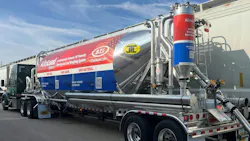
Genius in motion
Since Sisk founded the manufacturer—which specializes in pneumatic tank trailer equipment—in Park Hills, Missouri, in 1992, BTI has prioritized helping customers maximize their asset investments so they’re able to add drivers, grow their fleets, and make more money. The AutoLoad System checks those boxes and more, delivering safety, productivity, and compliance advantages that also help haulers retain top drivers and secure new business, advocates agree.
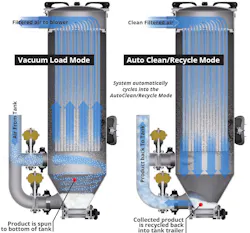
“When I first saw it at Tank Truck Week, it was intimidating and kind of scary looking,” Arledge recalled. “But when you watch it run and understand how the valves work and what the system’s doing, it’s a simple operation. It’s just the timing of valves opening and closing; and using the inches of vacuum inside that tank, the solenoid shifts those valves, closing the system away from the vacuum and opening it up to ambient air with a filter tube. That burst of air comes through in reverse and blows all the product right back into the tank.
“It’s genius, really. I take my hat off to BTI.”
John LaGrand, BTI’s AutoLoad national accounts manager, routinely receives similar reactions. He tells curious customers to follow the air. But the official system breakdown is more complex.
AutoLoad maintains system pressures, automates line switches, and ensures tank trailers fill evenly, keeping tandem axles within weight limits. AutoClean collects the dust generated by dry bulk transfers, keeping materials out of the air and off the ground, and purges the dust filter for 2 seconds every 5 minutes without losing vacuum. And AutoWeigh—AutoLoad’s newest system feature—adds a digital display and sensors that measure load weights within hundreds of pounds, so drivers aren’t traveling back and forth between scales and silos.
“We’re not only making the job easier for drivers, we’re saving fleets money on their equipment,” LaGrand said. “They’re not replacing pre-filters and broken fingers constantly or having to buy a new $10,000 blower.”
Carrier-tested, driver-approved
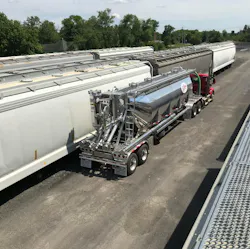
The project team, which included BTI President Andy Boyer and General Manager Todd Watkins, worked with multiple carriers to develop the AutoLoad system. Beelman Trucking supplied hydrated lime for early tests; Bulkmatic deployed the first units on vac tanks carrying PVC resin; and Ee-Jay’s feedback informed the final design, including valve timing and system controls.
AutoLoad can handle any dry bulk commodity, from semolina flour to adipic acid and carbon black, BTI maintains. But the system delivers the greatest ROI when handling the powderiest dusting materials, said Marc Powers, Ee-Jay owner and president, who currently runs four AutoLoad systems and plans to add two more this year. “When they described what AutLoad does, it was a no-brainer,” Powers said. “The system eliminates cleaning out rear canisters and blower filters, spills, and the risk of dusting materials destroying the blower.”
The “old way” of dealing with dusting made for a “crummy” driver experience, Powers added, forcing drivers to repeatedly stop and start operations, drag around hoses, climb on equipment, and hammer out clogged filters. Operation involves a slight learning curve—Ee-Jay pairs its most “tech-savvy” drivers with AutoLoad-equipped tankers—but once calibrated, the Bluetooth-connected system boasts “set-it-and-forget-it” simplicity, Powers attested.
“AutoLoad monitors everything,” Arledge confirmed. “Drivers hook up to it, set the parameters, and just watch over the thing. They love it.”
Carriers do, too—especially when it comes to preserving time and payload.
“It was taking Bulkmatic anywhere from six to nine hours to unload adipic acid,” Boyer shared. “Teams of drivers were having to shut down two or three times to empty out those 40-in. filtration canisters, and they’d end up throwing away half a super sack of material with every load. After we put AutoLoad in service with them, they got that time down to 90 minutes—with one guy and zero waste.
“After demonstrating we had a real solution, it’s taken the industry by storm.”
Failure-free performance
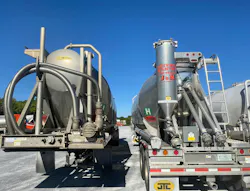
Jeff Null, J&M VP of operations, considered adding a second canister to one of J&M’s vacuum tanks to accelerate pickups of a powdery clay that was clogging up the system. Sisk says he’s seen other carriers take a similar approach, but Arledge didn’t want to go that route. He found the solution to J&M’s problem at National Tank Truck Carriers’ signature event in Houston.
Now J&M is running six AutoLoads that are supercharging operations.
“The first time we used it to transfer that clay, the guy who runs the silo said the best vac tanks could only open the butterfly valve to the third notch, and those valves have 10 notches,” Arledge relayed. “Previously, we could only open ours to the first notch, sometimes the second, so we started there, but Todd was with us, and he said we needed to open it more, so we went to the third notch—and it was still starving.
“We ended up opening that butterfly valve wide open, and it loaded 28 tons of product in about 40 minutes.
“On top of that, there wasn’t a coffee cup’s worth of material wasted.”
J&M also utilizes the PD Transfer upgrade for transloading tank cars, one of many applications for the AutoLoad system. And Bulk Specialties in Americas, Georgia, is a certified installer of the system, which retrofits to most dry bulk tankers, including units from Tremcar, J&L Tank, and Heil. They’ve even upfitted Super Flos for J&M and Tidewater. Another third-party shop partner also supplies AutoLoad-equipped trailers; and BTI offers factory installation via OEM partners, as well as training for carriers and maintenance providers who want to expand AutoLoad services.
“We introduced AutoLoad in 2022, so it’s going on for four years now—and we haven’t found one product it can’t handle.
“This system just keeps running and running.”
A new vac tank standard
That reliability, combined with attentive customer service and post sales support, is changing the game, Sisk maintains. And BTI is so confident in the technology, it allows fleets to test the AutoLoad system for pennies. “We have trailers set up here we’ll lease out for $1 a month, so people can use the system in the field,” LaGrand said. “So we put our money where our mouth is.
“Come get our trailer and try it out—one time is all it takes.”
Sisk goes further, saying people are starting to realize that not investing in an AutoLoad system is a “huge mistake,” leaving $100,000-plus pieces of equipment grossly underutilized. “You’re going to see this as a standard spec going forward,” he predicted. “Either that, or they won’t win new business—because they aren’t going to be competitive.” He also expects competitors to try, and fail, to recreate the system, which already is compatible with an automated future.
“It’s an all-around gamechanger for fleets that have been fighting all these problems for years,” LaGrand concluded. “The investment is a little bit more up front, but it pays for itself so quickly.”
About the Author
 Jason McDaniel
Jason McDaniel
Jason McDaniel, based in the Houston TX area, has more than 20 years of experience as an award-winning journalist. He spent 15 writing and editing for daily newspapers, including the Houston Chronicle, and began covering the commercial vehicle industry in 2018. He was named editor of Bulk Transporter and Refrigerated Transporter magazines in July 2020.