Technology in bulk: Insight roundup for tank truck operations
Key Highlights
- Trimac is transitioning to AI-powered cloud architectures to automate data integration during acquisitions, reducing manual effort and increasing agility.
- Experts say connected systems and direct API integrations enhance cybersecurity and simplify data sharing, making fraud prevention more effective
- Foodliner is embracing new Fleet Hub connectivity to improve driver safety, operational efficiency, and customer transparency.
- Tandem Concepts is partnering with Trimble to optimize the fuel loading processes, reduce driver delays, and increase process safety.

Trimac Transportation is integrating Service Transport Company’s newly acquired operational systems the “analog” way, using traditional architectures, hand-built ELT (extract, transform, load) staging frameworks, and computer-savvy IT craftsmen to “lift and shift” critical data. That’s not how Ross Ballendine expects to meld disparate tank truck-carrier technologies in future fleet acquisitions.
The vice president of information technology says Trimac’s IT team is rapidly advancing toward using artificial intelligence-created instructions to translate diverse programming languages—and enable fully automated digital transformation. “One of the things we’re doing at Trimac, which we’re excited about, is shifting to cloud-based data architecture, where data normalization happens through AI-generated code,” Ballendine shared. “So, for example, if we do an acquisition, and we’re introducing more elements into the mix, we can leverage code that automatically interrogates those systems, understands their architectures, and then builds the ELT logic that moves them into the cloud.
“We’re all heading that direction. It really is just a question of how far along folks are on that journey.”
Cloud-based systems, AI tools, and data normalization aren’t just concepts that make technophiles swoon either, Ballendine insisted. They’re all key factors in developing a modern operating environment that benefits the entire supply chain, optimizing business transactions and scalability, accelerating communications and workflows for employees, and simplifying repeatability for suppliers.
“In today’s interconnected world, a seamless transportation technology ecosystem is no longer a luxury. It’s a necessity.” Rishi Mehra, sector VP for Trimble’s North American transportation business, asserted in a “Connected Advantage” leadership panel during Trimble’s 2025 Insight Tech Conference that included Motorcity Systems President Bob Stemple, Rectangle co-founder and CEO Matt Salefski, and Ballendine, who helped bring bulk haulers’ technology concerns to light in The Big Easy.
See also: Trimac acquires Service Transport
Trimble CEO Rob Painter spotlighted Foodliner’s use of Trimble’s workflow innovations to compound growth during the opening session; Matt Galusha, Foodliner’s transportation technology special projects leader, provided a pre-recorded testimonial about their success using new Fleet Hub connectivity; Michael Kornhauser, Trimble sector vice president for transportation and logistics, revealed a new partnership with Tandem Concepts that aims to digitize processes at fuel loading racks, and Optym introduced its AI-powered optimization tech to curious tank truckers at the Insight Pavilion.
“With a seamlessly connected ecosystem, we can perform tasks that traditionally were very limited,” Salefski said.

Cloud-powered fleet productivity
Carriers clutching onto their on-premises servers may be celebrating because they didn’t experience disruptions during the recent Amazon Web Services and Microsoft Azure outages, but they shouldn’t, argued Salefski. “One of the amazing things about tapping into AWS, Azure, Google Cloud, or any other cloud provider, is you get the sum of all their other customers’ security packaged into one,” he pointed out. That includes work AWS does for “top-secret” government clients. And employees accessing closeted servers already are broadcasting sensitive data when logging in remotely.
Direct application programming interface (API) connections further fortify cybersecurity by eliminating third-party opportunities for fraud, he added. “The more connected systems are, the harder it is for bad actors to get into the middle and access data that they shouldn’t have access to,” Salefski said. “For example, if a load tender or an invoice is sent over email, that is a third-party opportunity for some nefarious actor to break into someone’s inbox, steal their data, and do bad things with it.
“So, I don’t think enough people are talking about how fraud is much harder to perpetuate when systems are directly connected.”
See also: Supplier Showdown winner turns bulk heads
Companies cannot forget the security basics—complicated passwords, multi-factor authentication, privilege management, and awareness training—when migrating to the cloud, Ballendine added. But they need to make the move because cloud-based connectivity unlocks other advantages, including real-time data sharing, career future proofing, and unrestrained growth potential. “[If you’re not in the cloud], I hope you’re not growing fast, because scalability is going to be a challenge,” he maintained. “It can be done, and it’s tempting. The sense of control it brings is enticing. The understanding of the mapping of your entire ecosystem is comforting, but scalability will not be there. The real-time data problem will continue to be an issue—and people and resources as well.”
Trimac, one of North America’s largest and most innovative bulk haulers, is leveraging its technology investments to enhance service for internal and external customers. The carrier now uses real-time weather alerts to keep drivers safe, transportation management system (TMS) connections to facilitate faster payouts, and a house-built application that integrates operations with a major fuel retailer. “And we have a long list of aspirations we want to get to beyond that,” Ballendine said.
Technology providers such as Motorcity and Rectangle can help carriers manage the change by advising where AI and automation make sense, explaining the pros and cons of API and electronic data interchange (EDI) transmissions, and outlining customized pathways to fully connected network adoption. “Reliability is key,” Stemple concluded. “Tolerance for downtime is zero. So, our focus is on developing systems that can change and adapt, and we can deploy without taking the entire ecosystem down. That is critical when we talk about cloud systems and interconnected technologies.
“The wheels should never stop—and the system shouldn’t either.”

Food-grade network visibility
Painter waxed poetic about the real-world success enjoyed by Foodliner—the largest bulk food-grade hauler in the country—using Trimble’s new AI tools to create a seamless transportation ecosystem that connects the physical and digital worlds, boosting productivity, profitability, and growth potential.
“Foodliner has already experienced the benefits of connected workflows with an array of our solutions: TMW.Suite for TMS, TMT fleet maintenance, and Copilot navigation,” Painter told attendees inside the Ernest N. Morial Convention Center’s New Orleans Theater. “But they still had one major challenge, and that was delivering the e-commerce experience for their customers, where they can instantly and accurately see where a load is and when it will arrive. Foodliner solved this by adding … real-time freight visibility directly into their existing TMS, thereby providing the transparency and confidence their customers require. And they’re not stopping there. Foodliner also is extending its ecosystem advantage by deploying our newest offerings: Trimble Fleet Hub and Trimble Smart Workflow.
“This powerful integration centralizes the connection between their Platform Science in-cab technology, as well as TMW.Suite, thereby closing communication gaps, and keeping their back office and drivers on the same page. It’s a powerful reminder value isn’t just in a new solution, but in the compounding power of connected solutions and workflows.”
See also: Trimble, partners unbox new technology
Kornhauser introduced Galusha’s testimonial about Fleet Hub, saying, “When drivers feel connected and supported, it impacts their overall satisfaction and ultimately your retention,” before rolling the clip. “I’m excited to talk about our fleet success using Fleet Hub,” Galusha said. “We’ve seen amazing improvements in speed and reliability, and just an overall better driver experience. We’ve just begun fully rolling out the technology to our operations, and the improvements so far have been dramatic.
“We’re excited to continue to move forward and expand our relationship with Trimble.”
Seamless fuel chain communications
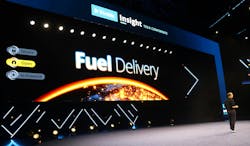
Trimble’s sector vice president also revealed a new partnership with fuel loading-rack communications startup Tandem Concepts, which is acclerating loading-rack interactions between fuel haulers and storage terminal operators.
“All of us are here today because of the businesses of hauling fuel,” Kornhauser said. “For fuel haulers, we’re moving beyond just managing trips; we’re accelerating the flow of fuel from the terminal to the tank. Today, we announce an ecosystem connection between our partner Tandem Concepts and Trimble Fuel Dispatch TMS. This connection creates a new standard of efficiency by eliminating the dreaded no-go. Gone are the days of drivers arriving at the terminal only to be blindsided by credit, allocation, or inventory issues. Tandem now front runs DTN allocation checks with the same verification protocol used at the rack ahead of the driver’s arrival [boosting carrier confidence].
“With the connection between Tandem and our Fuel Dispatch TMS, as soon as an order’s created, it’s instantly validated against the terminal. If there is a problem, the dispatcher gets an alert before the driver arrives at the terminal. After the driver finishes loading, the information is transferred electronically and updated directly in the TMS.
“This transforms a process that historically has been paper heavy and slow, making every single step safer, simpler, and more efficient.”
Look for more on Tandem Concepts in the December issue of Bulk Transporter magazine.
About the Author
 Jason McDaniel
Jason McDaniel
Jason McDaniel, based in the Houston TX area, has more than 20 years of experience as an award-winning journalist. He spent 15 writing and editing for daily newspapers, including the Houston Chronicle, and began covering the commercial vehicle industry in 2018. He was named editor of Bulk Transporter and Refrigerated Transporter magazines in July 2020.