Peak performance: The blueprint behind Heniff’s safety title
Key Highlights
- Heniff is the exclusive carrier approved to transport Shell's hazardous pyrolysis oil, routing it safely via rail and transloading to final delivery in Louisiana.
- The company has doubled its transload network to over 40 locations nationwide, including international ventures and new warehousing facilities, to support diverse bulk logistics needs.
- Heniff maintains a strong safety record with low accident rates, utilizing advanced technology like AI cameras, electronic logging, and real-time performance data to ensure compliance and safety.
- Strategic acquisitions and infrastructure investments have transformed Heniff into a comprehensive logistics provider, offering trucking, transloading, warehousing, and brokerage services.
- Leadership emphasizes a safety-first culture, continuous improvement, and leveraging technology to deliver responsible, reliable service to clients like Shell, earning industry awards and recognition.

Shell treats pyrolysis oil, or pyoil, as a “black-banded” product, meaning it’s a highly hazardous chemical that’s subject to the most stringent levels of health, safety, security, and environmental control. And because of its extreme risk profile, Shell doesn’t ship this feedstock over the road.
Or at least it didn’t until identifying the right tank truck carrier.
“We typically ship pyoil via rail, but we really wanted to think outside the box, and we wanted to see who would be a good partner to move that product into our Norco facility in Louisiana,” said Rosalinda Brinkmeyer, a terminal and road contracts manager who supports Shell’s chemical and polymer businesses. “For us, that was Heniff Transportation Systems.
“There were unique operational requirements, and multiple organizations had to be involved in the communications, and making sure the coordination occurred. And Heniff played an essential role in that. They worked closely with us to understand the requirements, confirmed we had the proper equipment, facilitated an open dialogue throughout implementation, and, most importantly, kept us safe. That was our primary goal—and Heniff delivered.”
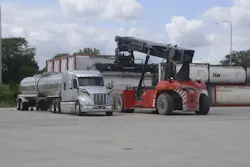
More than two years later, Heniff still is the only carrier cleared to handle Shell’s pyoil, which is routed by tank car to Heniff’s New Orleans facility, where the carrier transloads it to trailer for final-mile delivery. The work that went into making this ongoing feat of operational excellence possible earned Shell Chemical’s inaugural Refining Most Valuable Partners silver award. It’s also a shining example of what powered Heniff to National Tank Truck Carriers’ Harvison-division North American safety championship in the same calendar year.
Achieving both wins simultaneously indicates Heniff’s strategy—weathering freight recessions through intermodal expansion, while fostering a highly accountable, tech-driven culture—is a blueprint for scalable success.
“Safety and service sell. That’s all we have. That’s it—and that’s always been our top priority,” Heniff founder and CEO Bob Heniff said. “We’re going to be the safest, we’re going to provide the best customer service, and we’re going to create the most compelling company to do business with.
“That is how we’re going to win.”

Weathering the storm
Bob was busy building one of the industry’s biggest and best bulk transportation companies when Bulk Transporter last checked in on Heniff for its October 2021 cover story, “Best in Bulk.” The 2018 acquisition of Miller Transporters doubled Heniff’s size, and the 2019 purchase of Superior Bulk Logistics doubled it again, capping a series of nine pickups that transformed the Chicago-based carrier into a $600 million concern with 2,000 trucks and 5,000 trailers.
Five years later, following the historic freight recession, Heniff’s fleet is about the same size, with reduced volumes and M&A activity—slowed by often “unbridgeable” double-digit dips in valuations—conspiring against equipment increases. “There was a lot of wrongly perceived hope that we were going to start rocking and rolling with the change in administration,” Bob said. “And candidly, particularly in the chemical markets, you saw how detrimental tariffs were to North American businesses, just due to the nature of chemical manufacturing.
“We’ve seen many customer projects shelved because of the uncertainty.”
That doesn’t mean Heniff stopped moving forward.
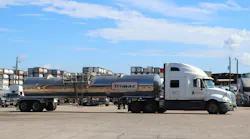 Trimac Transportation’s recent addition of California Freight reflects a broader strategic shift across bulk transportation, where securing specialized assets and capabilities—such as ISO tank services and tank-cleaning capacity—is now more critical than simply acquiring trucks.
Rather than forcing fleet growth in a depressed environment, the carrier utilized the unplanned downtime to optimize operations, enhance efficiencies, and aggressively swell intermodal capabilities. The goal was to evolve from a traditional tank truck carrier into comprehensive, one-stop bulk logistics provider by reinforcing the five pillars of its business. “Who knows what the economy will bring, but we’ve positioned ourselves to continue taking market share,” said Scott Templeman, Heniff chief operating officer. “We’re all about helping our customers with total supply chain solutions, and that includes trucking, our ISO depots and transloading services, our brokerage, and tank cleaning.”
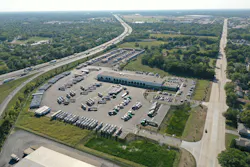
A solutions-based approach is driving massive infrastructure growth. Since acquiring Superior, Heniff has nearly doubled its transload network to 40-plus locations nationwide, with 15 offering food-grade transfers. The carrier also ventured out internationally, introduced fresh warehousing services, established new cleaning facilities, and forged sustainability partnerships—all while swelling tank storage to more than 1 million gallons in Texas alone.
Yet Heniff’s managers never lost sight of the founder’s core tenets.
“Yes, we won the Heil for the trucking piece, but it’s only one part of what we do,” Templeman said. “And we preach safety in every endeavor we undertake. From the drivers to the guys who clean tanks, the technicians, and the transloaders—everybody must do their job well.”
Uncompromising accountability
Global petrochemical producers like Shell demand excellence. And Heniff’s ability to deliver responsible service across every business unit makes it one of Shell’s primary bulk logistics allies. The carrier hauled 1,542 chemical loads for Shell’s Norco and Geismar, Louisiana, facilities in 2025—without any on-highway incidents that endangered the motoring public.
“Heniff always demonstrates safety is more than a metric,” Brinkmeyer said. “It’s part of their culture, and throughout all the work I have done with Heniff, including the pyoil project we worked on together, they’ve consistently approached every operation with professionalism.”
That competency is tested daily at Shell’s Geismar plant, which is notoriously strict regarding HSSE compliance, Brinkmeyer attested, turning it into a proving ground where only the most diligent carriers thrive. And to guarantee those standards are upheld, Shell’s security team conducts Business Performance Reviews with Heniff twice per year, scrutinizing its safety performance, any incidents or rejections, and terminal communications.
“We take safety in operations very seriously,” Brinkmeyer emphasized.
 tank_truck_safety_editorial
 Ronnie McCoy, SWTO manager of fleet safety, training, and compliance, raises his plaque in celebration upon hearing his company revealed as the private-fleet Grand Champion in National Tank Truck Carriers’ 2025 North American safety contest during the 2026 NTTC Annual Conference in Baltimore.
But true accountability goes beyond flawless execution. It’s also determined by how companies respond when challenges inevitably arise. And, in Heniff’s case, leaders don’t disappear, Brinkmeyer said. Instead, they show up, conducting joint analyses at Shell facilities, ensuring procedures are reviewed and transparently refined to prevent recurrences. “When we’re talking about protocols and compliance, there’s a lot to it, but it’s important,” said Leon Lupina, Heniff’s vice president of safety. “And in the grand scheme of things, the drivers who routinely do what’s right typically are the ones who are most successful.”
Lupina would know. He entered the tanker industry in 1985 and spent 13 years as an owner-operator before transitioning to safety. Now he’s responsible for the well-being of 2,000 drivers in a role that necessitates top-down support, constant vigilance, complementary equipment and technology, and the coordinated effort of an elite team featuring Terry Kolacki, a past NTTC Safety & Security Council national chairman who came to Heniff from GLS Transport, and—until his recent retirement—Phil Gardner, who arrived via Miller.
Both helped their previous employers win Heil trophies.
“We didn’t have much of a safety program before Leon arrived nearly 20 years ago,” Templeman said. “But he’s worked very hard to nurture our culture, develop this program, and get everyone working together.”
Defending the fleet
Heniff’s average length of haul is declining as intermodal moves accelerate. But load counts are up, and Heniff’s drivers still covered 113 million miles in 2025 while collectively posting a company-best 0.160 accident frequency, which translates to only 18 DOT-recordable accidents.
That count initially stood at 32 incidents. But Lupina—who admits he’s both driver advocate and safety stickler—refuses to accept initial reports at face value. So he regularly utilizes internal crash analyses and the Federal Motor Carrier Safety Administration’s DataQs system to reevaluate situations and remove non-preventable accidents from drivers’ records, resulting in consistently low Compliance, Safety, Accountability scores—and elevated awards applications.
“I spend a lot of time on DataQs,” Lupina said. “I look at that information all the time, basically daily, and the system has improved. I wish we could get FMCSA’s determinations faster, but that process is critical. And the companies that aren’t actively monitoring federal crash data, and challenging incidents that fit the agency’s criteria, are really missing the boat.
“Not paying attention is a big mistake.”


So is not taking advantage of technology. To keep incident counts low from the get-go, Heniff relies on a proactive tech stack powered by an IT team that enjoys engineering fixes for customers and employees alike. The in-house Heniff Connect app combines digital workflows—including proof of delivery and authority to unload—with data from AI-powered Samsara cameras and Platform Science electronic-logging devices in a user-friendly system that allows drivers to access real-time performance metrics. And custom scorecards track standard regulatory compliance like hours of service alongside business-based qualifiers, giving fleet managers the insights they need to correct behaviors with targeted training.
“Joe Neal, who is our chief technology officer, and his team put in a lot of work on the front end, so the back-end work is easier for dispatchers, drivers, and our customers,” Templeman said.
“That helps tremendously—ensuring we’re working smarter, not harder.”
Heniff’s proprietary software is bolstered by a comprehensive arsenal of safety and communication tools, including Sentry Road modules for ongoing education, truDigital signage for vital updates, and Bendix Wingman Fusion for advanced driver assistance on Peterbilt trucks. Video data also guides legal strategy, allowing Heniff to quickly settle claims if genuinely at fault. And the carrier incentivizes expectations with robust bonuses, so drivers who meet the standard are financially rewarded for their proficiency, keeping total turnover at 33%.
“Bob never says no when it comes to spending money on safety,” Lupina said.
Ultimate validation
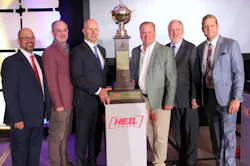
The culmination of that disciplined, data-driven strategy is the company’s first championship trophy with the Heniff name etched into it, proving intermodal expansion and efficiency gains are achievable—even amid unfavorable conditions—without sacrificing stewardship. “We also won Grand awards in 2020 and 2023, when our program was as good as it was in 2025, but we didn’t win the Heil those years,” Lupina said. “So we’ve done a great job.
“Winning our division three times in six years validates our approach.”
While this is the first trophy to bear the Heniff nameplate, it’s actually the fifth in the combined organization’s historical lineage—joining prior wins by Miller (2006 and 2015), Superior (2013), and Lemmon Transport (1978), which Superior absorbed in 1984. Integrating those legacies, however, was no accident. Backed by private-equity owner Olympus, Bob and his board of directors share a unified, uncompromising vision for scaling the specialized logistics network. Rather than pursuing “turnarounds” that require rehabilitation, the company strictly targets entities that already possess equally careful cultures.
“The underlying safety standards are paramount in acquisitions,” Bob said. “I’ve done turnarounds. I won’t do one again. They take three times the energy and you still lose folks who won’t buy in.
“It’s not worth the effort.”
Smooth integrations better protect the public and keep soaring insurance premiums in check—a benefit compounded by Heniff utilizing its own risk retention group to self-insure third-party liability lines—providing a competitive advantage in today’s litigious environment that allows it to keep supplying award-winning service. “I’m not surprised they won,” Brinkmeyer said. “It’s well-deserved.” The only task left is to celebrate this achievement—and then prepare for what’s next. “This was the first win, but it shouldn’t be the last,” Templeman said.
Not if it’s up to the man whose legacy is at stake. For Bob, capturing the industry’s highest honor simply sets a new baseline as Heniff attempts to capitalize on slowly improving circumstances.
“At first, it was a relief,” Bob said of his initial reaction to the Heil breakthrough.
“But, really, it’s just the evolution. It’s our turn now. I truly believe we’ve improved upon those championship legacies over time—and we’re not content. We’re always striving to be better.”
About the Author
 Jason McDaniel
Jason McDaniel
Jason McDaniel, based in the Houston TX area, has more than 20 years of experience as an award-winning journalist. He spent 15 writing and editing for daily newspapers, including the Houston Chronicle, and began covering the commercial vehicle industry in 2018. He was named editor of Bulk Transporter and Refrigerated Transporter magazines in July 2020.