Feeding the future: ADM establishes new tank cleaning facility
Key Highlights
- ADM operates North America's largest private barge and rail fleets, supporting its role as a major grain origination and food processing company.
- The new ADM Trucking tank trailer cleaning facility features automated, Kosher-certified systems with digital record-keeping, enhancing safety and traceability.
- Investments in equipment and infrastructure improve operational efficiency, reduce environmental impact, and support ADM's commitment to food safety and quality.
- Partnership with The Peacock Company provided expert guidance in system design, installation, and operational integration, ensuring minimal disruption and maximum efficiency.
Unlike many of its well-known customers—who include some of the largest food and beverage brands in the world—food ingredients supplier ADM typically operates behind the scenes. But the Fortune 50 company boasts one of North America’s most robust transportation networks, with the biggest privately held barge and rail-car fleets in the United States, and ADM Trucking, a tank truck fleet that runs 550 trucks and 1,200 liquid and dry bulk trailers.
“We’re a grain origination company,” shared Steven Finn, ADM vice president of North American truck transportation and logistics. “We originate grain products and move them through our network. But after we collect grains, we process them and turn them into food and feed ingredients. So, we’re a grain company at the origination side, but we’re also a food processing company, and become more of a nutrition company closer to the customer.
“All of that requires a lot of equipment. So, we’ve invested heavily in assets and transportation resources throughout the organization.”
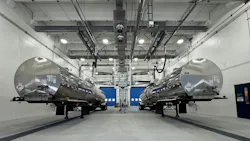
ADM’s latest investment is a brand-new, multi-million-dollar tanker cleaning facility designed and outfitted by The Peacock Company. The six-bay, food-grade wash rack, built next to ADM’s 30-year-old eight-bay facility in Decatur, Illinois, to avoid disruptions, features low-volume, high-powered cleaning, on-demand heating, and heavy-duty blowers—all ins a smaller footprint—boosting operational efficiency, equipment uptime, and visibility.
“We take quality and food safety seriously,” Finn said. “That’s why we decided to invest in a state-of-the-art wash facility.”
Quality partnership
ADM is serious about service, too. That’s why the company operates ADM Trucking, as well as an in-house transportation group and a brokerage. And service without safety is senseless, so ADM takes securing the food supply chain just as seriously. That means caring for the products it hauls, such as sweeteners, edible oils, and flour; and the equipment it uses, including a fleet of primarily Mack trucks; and Walker, Brenner, and Polar tankers.
To support that mission, ADM leaders did their due diligence before deciding how to upgrade the most important location in a network of eight cleaning facilities, considering the options, like rebuilding or replacing the old rack; talking to industry partners and touring their locations; and researching vendors. “When we started this process, we were looking for someone to do everything and then drop in a turn-key system, but that doesn’t really exist,” Finn said.
“So, we looked at folks with cleaning equipment expertise—and Peacock was the right choice for us.”
ADM first approached Peacock in 2023. After two years of permitting, planning, construction, and system installation, ADM began using the new facility alongside its old one earlier this year.
Finn expected to complete the transition in February.
“Peacock had supplied ADM with equipment at two of their smaller wash facilities, but nothing to the scale of this project,” said Miranda McMas, Peacock special projects manager. “So, we worked closely with ADM, their architects, and contractors over the next two years, advising on operational matters, as well as building and equipment layout and installation.”
Precision under pressure
Peacock’s cleaning equipment arrived fully assembled on skids, simplifying the installation. All ADM had to do was place and anchor the equipment, hook up the utilities, and add ventilation. The system passed all ADM’s quality and food safety tests upon startup, and activities never stalled, ensuring cleaning continuity for ADM Trucking and its customers.
“Miranda and Robby [Day, Peacock VP of operations] were easy to work with,” Finn attested. “They’re great partners.”
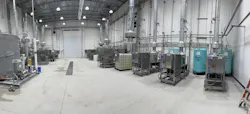
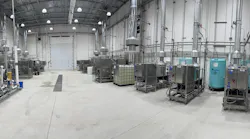
Peacock’s Model 660 food-grade cleaning system enables single-pass, Kosher-certified washouts. Complete with stainless-steel frames, tanks, piping, and coils, 660s run at up to 210 degrees Fahrenheit at 600 psi, without requiring a boiler. “Each machine has a dedicated PLC, allowing washes to be product-tailored, along with digital recording and certificate printouts that include time, temperature, seal numbers, prior products, operator ID, and more,” McMas said.
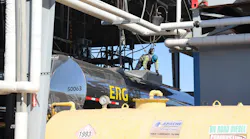
ADM also purchased three Model 3126 high-pressure hot water handgun systems for exterior cleaning, including cabinets and pumps. The stainless-steel units allow for the use of multiple pressure wands up to 10 gpm per machine, running at 2,000 psi up to 180 degrees, McMas said. Further system specs include a blower system for drying clean tanks and circulating air in confined-space entries, center-mount mezzanines with dual gangways for safe manhole access, food-grade filter housings, hose reels, sinks for cleaning fittings, a high-capacity water softening system, and remote touchscreen controls for operators.
“Efficiency was the top priority on their list,” McMas said.
Sustainable efficiency
Rapid on-demand heating reduces wash time and eliminates the need for hot-water holding tanks or a steam heat exchanger, allowing ADM to continue cleaning up around 3,500 trailers every month while downsizing. The advanced system also boosts safety, sustainability, and record-keeping, Finn said. “The paper trail, with the temperature and duration of washes, is very important to us,” he explained. “And we were able to integrate the system with our in-house operating system, because the systems speak the same language.
“That integration, along with the automation, are a game changer for us.”
High-pressure, low-volume spinners also use less water, reducing the residual waste entering ADM’s nearby wastewater treatment plant. And with the office in the middle and three bays to each side—two for sweeteners, four for refined oils—the facility is set up for expansion. “It was a pleasure working with ADM,” McMas said. “The Peacock Company feels privileged to have been involved in such an exceptional and impressive wash facility.”
Next on ADM’s agenda is a “redeployment of assets,” Finn said. The company plans to reserve two of the old facility’s eight bays for external cleans and convert the remaining six into a maintenance and repair shop that replaces a dated five-bay garage—another advantage to going big. “The fact that we invested in a brand-new facility so close to our two biggest processing plants demonstrates ADM’s commitment to quality and food safety,” Finn concluded. “We don’t have to worry about the equipment going in and out of our facilities.
“We know it’s clean, dry, and odor free.”
About the Author
 Jason McDaniel
Jason McDaniel
Jason McDaniel, based in the Houston TX area, has more than 20 years of experience as an award-winning journalist. He spent 15 writing and editing for daily newspapers, including the Houston Chronicle, and began covering the commercial vehicle industry in 2018. He was named editor of Bulk Transporter and Refrigerated Transporter magazines in July 2020.