Engineered for longevity: ‘Old-school’ service is Ridewell’s edge
Key Highlights
- Ridewell focuses on air ride suspensions for the vocational segment, targeting 50,000-70,000 specialized trailers annually, including tanks, rather than mass-market dry vans.
- The company emphasizes over-engineered, safety-focused products with a world-class warranty, supporting customer success and long-term loyalty.
- Ridewell invests heavily in automation and process improvements, doubling throughput and maintaining a high equipment efficiency of 87%, ensuring quick lead times and product availability.
- Strong industry relationships, especially with OEMs and dealers like STE, underpin Ridewell’s market resilience and support for the tank trailer segment’s growth.
- The company maintains a family-oriented culture, prioritizing employee loyalty, community values, and continuous innovation to stay ahead in a competitive market.
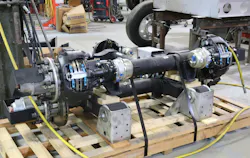
Springfield, Missouri, is a hotbed for innovation in heavy-duty truck and trailer suspensions. Reyco Granning Suspensions grew out of Reynolds Manufacturing, which started in 1924 in Springfield; C. Ted Hutchens founded Hutchens Industries there 26 years later; and John Raidel Sr. left Reyco to open Ridewell Suspensions in the “Birthplace of Route 66” in 1967.
All three are still operating today. Only one zeroed in on specialized trailers at the outset.
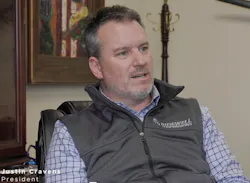
“We focus on supplying air ride suspensions for the vocational segment,” said Justin Cravens, Ridewell president. “So we don’t go after the biggest trailer manufacturers in North America, the guys who build the dry vans, reefers, high-volume flatbeds, and chassis trailers. We focus on the 50,000-70,000 specialized trailers built every year—and tank is a key part of that.”
Editor’s Note: For an inside look at the facilities and equipment in this article, visit our expanded media gallery. This collection highlights Ridewell’s Springfield manufacturing plant inside and out, showcasing the advanced automation and the skilled teams driving its success.
Heading into its 60th-anniversary year as a third-generation, family-owned company, Ridewell continues to hold its own—even while competing against much larger suspension manufacturers—producing steady, incremental growth amid challenging market conditions by emphasizing performance and durability, parts availability, and “old-school” engagement. “We like to say we don’t participate in downturns,” Cravens said. “A lot of times, when business is slow, big companies cut their workforce and trim expenses. We do the opposite. We increase our marketing budget, encourage our guys to travel more, and cater to customers heavier.”
“That’s when Ridewell really goes hot.”
To prepare for the next trucking upturn, which has shown sporadic signs of finally materializing, Ridewell also is reinvesting in the business—expanding factory automation, honing production processes, and strengthening relationships with leading service providers, dealers, and OEMs like STE—another family-owned company laser-focused on tanks. “Our partnership with Ridewell has been a cornerstone of STE’s growth and success,” said Chris Sipe, STE president. “Their unwavering dedication to the tank trailer market is matched only by their execution.
“Time and again, they deliver engineered excellence right on schedule, backed by a powerhouse, industry-leading warranty that gives both us and our customers total peace of mind.”
Radically reliable leadership
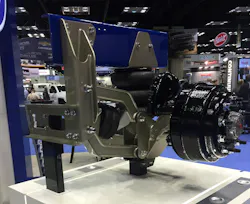
John Sr. was the head of engineering at Reyco in the 1960s. He left to focus on building air ride suspensions—then considered a “radical” technology that made little sense. Today, air ride systems account for over 75% of the suspensions on heavy-duty trailers. “I was at Hutchens industries in the early 90s, when air ride first started picking up steam, and we still thought people were crazy for spending that much money on a trailer suspension, and adding that much weight,” said Darin Bridges, Ridewell vice president of sales and marketing.
“But you look at the market today, and most of it has gone air ride.”

John Raidel II, who understood both the technical and financial sides of the business, slowly grew Ridewell during his reign; and the family groomed Jack Raidel, current owner and CEO, to lead from Day 1, Bridges said. “The old adage is: first generation starts it, second grows it, and third spends it,” he said. “Jack is not keeping the profits for himself. He’s investing in the company, with a lot of automation, and he takes as much pride in it as his granddad did.”
John was a hands-on instructor, so he insisted Jack learn the mechanical aspects of the business early on. Instead of watching TV, he was rebuilding carburetors or trying to figure out how to use a hand file to turn a square piece of metal into a perfect circle. “I’ve been instilled with the responsibility to continue my grandfather’s legacy—and I am happy to do so,” Raidel shared.
“I’m passionate about it, so that’s all I want to do.”
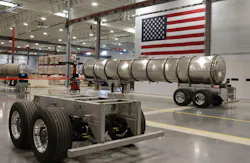
Ridewell today employs 170 people at two locations: the main 200,000-sq.-ft. manufacturing facility and headquarters in Springfield and a 45,000-sq.-ft. secondary facility nearby that builds auxiliary suspensions. The company maintains a highly diversified client base, with over 800 OEM, dealer, and shop customers serving the tank, dump, and heavy-haul trailer industries—and leaders hold on tightly to the old-school values John Sr. instilled decades ago. “Our customers base is loyal to us, and we’re loyal to them, we pay our employees well, and we treat our suppliers like family,” Cravens summarized.
That’s why people tend to stick with Ridewell. Cravens is in his 26th year at the company, and John McNellis, VP of operations, is in his 27th. “I’ve had opportunities to leave over the years, but the family atmosphere kept me here,” McNellis said. “Over and over, I’ve watched the Raidel family stand behind everything they do.
“Even when they don’t have to, they always step up and take care of customers and employees.”
‘Over-engineered’ for excellence
With a culture that emphasizes small-fleet responsiveness and shared success, the company’s people sell Ridewell as much as its products, Bridges said. But the products are premium, too, delivering elite driver comfort, load security, and dependable durability compared to traditional dry van leaf spring suspensions. And, as an early air ride innovator, Ridewell holds over 70 patents related to the technology, covering everything from the stress-reducing axle connections in the RAR-240 line to the clamped-in pivot bushings in most of its systems.
“We’re not just trying to make a sale,” McNellis said. “If our customers are successful, then we’re successful.”
Mechanically, air ride suspensions are fairly simple. They consist of hangers, beams, air bags, and shocks. The difference is in the details, including component materials, production and assembly processes, and application customization. And Ridewell continues to iterate, modifying and adapting designs in response to regulatory changes, lightweighting initiatives, and emissions considerations; and developing new systems, like axle-less suspensions.
That’s why the 59-year-old company now carries over 50,000 unique SKUs.
“Our suspensions are over-engineered for safety and serviceability,” McNellis stated. “We’re well-versed in the rougher environments our equipment operates in, so it’s made to withstand extreme situations, curbing events, and overloads; the ‘wearable’ parts are designed to last a long time and be easy to replace; and we do live builds of prototypes and thoroughly test every new product before it’s ever allowed to go out in the field with a customer.”
The real-world result is a world-beating warranty percentage.
“One percent is world class, 3% is good, and we’re below 1%,” Bridges said. “And, if a customer does have a problem, they don’t call in and get all these bureaucratic levels and eight-page forms to fill out.
“Ridewell takes a more personal approach.”
Leveling the production field
The company implemented a multi-tiered method for procurement post-pandemic. Material and component suppliers are ranked and regularly reevaluated based on pricing, performance, and lead times. Most items are sourced domestically. Some critical components—like the U.K.-made bushings used in a suspension Ridewell unveiled in 1977—still come from outside the U.S., but McNellis is seeing some “near-shoring.” “One of our key bushing suppliers is opening a new facility in the U.S. in August,” he said.

Production is prioritized by “focus-factory” objectives. The blue team handles higher-volume products; the gray team manages the fabrication line, where raw materials are transformed; the red team oversees truck-side and low-volume suspension operations, and the green team assembles complete axle systems, which now account for 30% of Ridewell suspensions. “By organizing production that way, we can take the higher variability we have and narrow it down to certain product lines within our overall production floor,” McNellis explained.
Advanced technology is optimizing Ridewell production capacity, consistency, and efficiency. Factory floors now feature approximately 30 automated systems, including robotic cells, material-handling machines, and powered lines. Combined with 100 highly skilled manufacturing and warehouse employees, the company has doubled throughput over the last five years—and recently increased overall equipment efficiency (OEE) to an exceptional 87%.
“The Raidel family’s willingness to invest in new equipment, tools, and anything else we need to be more efficient, never ceases to amaze me,” McNellis said.
Ridewell stocks its most popular models, helping suppress leads times to under five weeks over the last 18 months. When the plant’s busy, workers pull from the surplus, and they refill it when business slows, stabilizing production schedules. “We can’t control demand, but we can level our production,” Bridges said. The company also maintains stocking programs with dealers across the country, from truck-part giants like FleetPride to most tank-specific suppliers.
“Relationships with the distributors are critical,” Cravens said. “So we’ve put a big emphasis on that in the last few years, making sure they know what the key parts are and they have them on hand.”
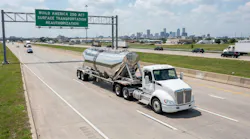 The BUILD America 250 Act includes a significant 10% dry bulk axle variance favored by tank truck stakeholders, including NTTC leaders, alongside reforms supporting vehicle weight limits, workforce development, and safety regulations, though some provisions face opposition.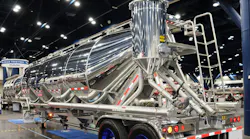
Defying all downturns
FTR recently slashed its 2026 trailer production forecast by 45 percentage points, tempering Cravens’ expectations for year-end results amid ongoing tariff uncertainty and rising fuel prices, but Ridewell isn’t panicking. “The market determines our goals, and they’re still based on last year’s forecast,” Cravens said. Instead, Ridewell is staying hot, adding automation, refining processes and designs, and expanding industry partnerships. Ridewell recently joined STE to boost support for National Tank Truck Carriers’ industry advocacy efforts.

And, while every segment Ridewell serves is important to Jack, the company’s deeply rooted connections with tank trailer industry partners are one of the biggest factors in its enduring success. “It’s not just a business transaction, especially with a company like STE,” Jack said. “I care about their future, and they care about ours, because we both want to be there to help each other.
“When you move beyond transactional relationships, that’s when companies really flourish.”
Ongoing projects are expected to further improve productivity and flexibility, allowing Ridewell to sustain growth amid changing times without expanding its existing footprint or workforce. And Ridewell’s sales and engineering teams are constantly working on new ways to solve problems, whether it’s collaborating with OEM partners to help update their processes or enhance serviceability, adding new capabilities, or using AI to streamline workflows.
“Ridewell is so well-diversified that no one customer generates more than 5% of its business,” Bridges said. “And the company’s never been big on acquisitions or taking on debt. It’s incredible.
“It’d be very difficult to recreate a company like Ridewell today.”
About the Author
 Jason McDaniel
Jason McDaniel
Jason McDaniel, based in the Houston TX area, has more than 20 years of experience as an award-winning journalist. He spent 15 writing and editing for daily newspapers, including the Houston Chronicle, and began covering the commercial vehicle industry in 2018. He was named editor of Bulk Transporter and Refrigerated Transporter magazines in July 2020.