AI won’t fix a broken transportation operation
Key Highlights
- Focus on solving specific operational problems rather than adopting AI for its own sake to ensure tangible value.
- Agentic AI moves beyond answering questions to actively participating in workflows, requiring better data, rules, and connectivity.
- Avoid tying core systems to a single AI model or provider to maintain flexibility as technology and models rapidly evolve.
- High-quality data is critical; poor data leads to bad decisions, especially as AI moves from recommendations to active participation in workflows.
- Design systems that can adapt to future AI improvements, enabling seamless integration of new capabilities without major rebuilds.

Artificial intelligence is everywhere in transportation right now. Software companies are talking about it, conferences are building sessions around it, and operators are being told they need an AI strategy.
But many industry stakeholders are asking the wrong questions.
Instead of wondering, “How do we use AI?” a better question is: “What problem are we actually trying to solve?”
That query was at the center of the Artificial Intelligence Panel at Mansfield Energy’s D1 Expo in Nashville. The discussion featured Joel Davies, vice president of marketing at Gravitate; Stefan Luger, head of sales at CommodityAI; and me. The panel was moderated by Michael Mansfield Jr., chief operating officer of Mansfield Energy.
What made the conversation useful was that it quickly moved past the normal AI hype, diving into where the technology can actually help, where human judgment still matters, and what starts to change when AI becomes more active inside real transportation workflows.
AI has been here longer than you realize
Transportation has been using forms of artificial intelligence for years. Route optimization, predictive analytics, inventory forecasting, machine learning and automated planning are not new ideas.
What’s changing now goes beyond accessibility.
More companies can use advanced AI without building large internal data science teams, but the bigger shift is how businesses are starting to think about the technology. For a long time, companies were mostly AI-friendly. They experimented with tools, added AI features, and looked for isolated places where automation could save time. Now some are moving toward more AI-centric operating models, while others are focused on building AI-enabled ecosystems where systems and data are connected well enough for different AI capabilities to plug in where they make sense.
One point that surfaced during the discussion was that not every transportation platform needs to become an AI company. I favor a more flexible approach centered around building systems that can take advantage of the right AI capability when it provides tangible value.
That distinction matters because the future may not be one giant AI system running everything. It may be a mix of specialized tools, operational systems, and AI capabilities working together.
Agentic AI changes the conversation
This is also where agentic AI starts to make the discussion more interesting.
Traditional AI helps answer a question, make a prediction, or surface information. Agentic AI goes further by working through a series of steps—monitoring changing conditions, interacting with other systems, and helping move a workflow forward. In transportation, that could mean identifying that a location is trending toward a runout, reviewing inventory, looking at upcoming deliveries, evaluating capacity and surfacing the issue with recommended options. That’s different from putting a chatbot inside a transportation system and calling it AI.
The real shift happens when AI begins participating in the workflow rather than simply answering questions. At that point, companies must think harder about the data, business rules, and guardrails behind those decisions. And that’s where connectivity becomes critical.
An AI agent can only make useful recommendations based on visible information.

Model lock-in is a real concern
Another part of the AI conversation that doesn’t get enough attention is how quickly the market itself is changing.
The model considered best for a task today may not be the best six months from now. Different models are already better at different things, and the leaderboard can move quickly. That creates real concern when a transportation platform is built around one AI model or one provider as a core dependency. That leads to another word of caution: Don’t peg the core of a TMS to a single model while performance, capabilities, and economics are changing this quickly.
Companies should be asking simple questions: If something better comes along, can we switch? Can different models be used for different jobs? Or has the core operation become so tightly tied to one provider that changing it turns into a major technology project?
The economics matter, too.
With agentic AI, one action from a user can trigger multiple AI interactions behind the scenes. An agent may gather information, query another system, evaluate the response, and take several additional steps before the user sees the result. That means companies need to understand what AI consumption looks like at scale, not just what one prompt costs. Even if unit pricing improves over time, total AI spending can still climb as companies give these systems more work.
Bad data produces bad decisions
Technology people have used the phrase “garbage in, garbage out” for years. That hasn’t changed. If the data is bad, the output will be bad. If the process is broken, automating it does not suddenly make it better.
The warning here is straightforward: If you have a bad process today, AI can help you execute that bad process faster. If you have poor operational data, AI can help you make bad decisions from that data at a scale and speed we haven’t seen before.
To sum it up: Garbage in, garbage out—only much faster now.
That problem grows more serious as AI moves from recommending actions to participating in the workflow itself.
Start with the operational problem
One of the strongest themes from the panel was the importance of starting with a real business problem instead of the new tech.
Where are people wasting time? Where are systems disconnected? Where are decisions being made without enough information? Where are customers experiencing friction? Those aren’t flashy questions, but they’re usually the right ones.
Dispatch is a good example. The goal shouldn’t be to eliminate the dispatcher. The goal should be to eliminate the work that keeps the dispatcher from dispatching.
AI can help identify risks, prioritize exceptions, and bring the right information together faster. Agentic AI may eventually help coordinate some of the steps around those exceptions as well. That idea kept coming up throughout the discussion: the label matters less than the outcome. If the technology helps someone make a better operational decision, it has value.
The business problem always comes first.
Human judgment still matters
Transportation still involves decisions where context, relationships, and judgment matter.
A system may identify a delivery is likely to be late, but somebody still must decide whether to move another load, call the customer, spend more money to recover the delivery, or accept the service issue. Those decisions often involve factors that are difficult to fully represent in data. Technology can understand the available information, but a person may understand the broader situation in a way the system doesn’t. And that distinction matters because transportation is still a relationship business.
The human side of the industry was clear during and after the D1 panel. The topic on stage was artificial intelligence, but a lot of the conversations afterward were about real operational problems, customer expectations, and everyday decisions companies are trying to make.
The best use of AI should create more time for those situations—not remove the person entirely.
 fuel tank trailer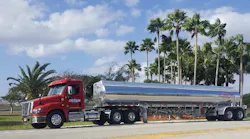
Smaller carriers have much to gain
AI could be especially meaningful for smaller and midsized transportation companies.
For years, some of the most advanced transport tech was concentrated among larger organizations because they had the resources to buy it, build it, and support it. But that gap is shrinking. A smaller carrier shouldn’t need a team of data scientists to benefit from better forecasting or exception management. Technology should work in the background, helping the operation make better decisions.
Agentic AI could make that distinction more significant because smaller carriers often have fewer people watching more parts of the operation.
For smaller carriers, the goal should not be to become a technology company just to compete. Instead, technology should make a smaller team more capable—not burden them with another complicated system to manage.
Customer expectations will keep evolving
There’s another pressure building at the same time, and it has less to do with the technology itself.
Customers are getting used to faster answers, better visibility, and more proactive communication everywhere else in their lives. Eventually they stop thinking about the technology behind those experiences and simply expect that level of service. Transportation will be no different.
Customers are not going to care whether artificial intelligence was involved in getting their delivery there on time. They’ll care that it arrived, they knew what was happening, and potential problems were identified early.
Eventually, customers may stop thinking of those experiences as AI at all. They’ll simply view them as the expected level of service.
Build for change, not today’s AI
If there is one overarching takeaway from this discussion, it’s that transportation companies should avoid designing their future around whichever AI model happens to be leading the market today.
The models will change. The economics will change. Agentic capabilities will improve. New providers will emerge, and different models will continue to be better at different types of work. So flexibility matters. A transportation operation should be able to take advantage of better forecasting, better optimization, and better AI agents as those capabilities emerge without having to rebuild the systems underneath the business. That’s why I favor an ecosystem approach: take advantage of the best technology as it changes rather than building an operation around one model and hoping it stays the best.
The critical questions won’t revolve around whether transportation companies use AI. They’ll be about whether those companies use it in a way that improves their operation, if they can control the cost and risk around AI—and their ability to adapt when something better emerges.
AI will keep moving forward. But the business problem is still the starting point.

About the Author
 George Thellman
George Thellman
George Thellman is the director of business development and strategic relations at TrueTMS. Thellman previously spent five years with TMW Systems and one year with Trimble Transportation before joining TrueTMS in 2021.