Show me the money: Where AI delivers real value for bulk fleets
Key Highlights
- AI enhances dispatch planning by managing multiple constraints in real time, saving hours and increasing decision consistency.
- Embedding validation within workflows helps prevent costly errors related to equipment compatibility and compliance before they occur.
- Automating administrative tasks like billing and payroll reduces manual effort, accelerates payments, and improves accuracy.
- Improved equipment visibility and data integration lead to better trailer utilization and reduced idle time.
- Successful AI implementation requires overcoming data fragmentation, ensuring system integration, and fostering user adoption within existing workflows.

Tank truck fleets operate under different rules than most trucking operations.
Equipment is specialized, and commodities must be handled correctly to avoid contamination. Dispatch decisions depend on tank compatibility, wash requirements, driver qualifications, and customer production schedules. In many fleets, those decisions still rely heavily on experienced dispatchers who understand how all these factors come together.
Risks for bulk transporters are focused in a few areas: specialized, underutilized equipment; labor-intensive operations; and errors in compatibility, compliance, or scheduling—all areas still heavily reliant on experienced dispatchers.
As artificial intelligence gains attention across the industry, bulk operators are asking a practical question: Where does it actually help?
Focus on the operational problems
In bulk transportation, most inefficiencies stem from day-to-day business challenges. Dispatch planning is complex and time-consuming; equipment is often underutilized; and manual billing and compliance processes increase delays and the potential for errors.
These are not new problems, but they are areas where technology is able to make a measurable difference when applied correctly.
One reason these problems persist is that many fleet systems were designed as systems of record. They capture what has happened (such as loads, miles, and invoices). But systems of record do little to help teams decide what should happen next.
AI delivers more value when it is applied within systems of action. Tools that support immediate decision-making inside dispatch workflows, where operational choices are made, yield the greatest benefits of AI.

Where AI delivers value
Fleets are beginning to see value from AI and automation in a few specific areas, particularly when they are embedded directly into business processes. These include:
- Dispatch planning: Planning loads for bulk operations requires managing multiple constraints at once. Systems of action that incorporate compatibility, availability, and timing into dispatch workflows can help planners evaluate options in real time and make faster, more consistent decisions, often saving dispatchers several hours per week.
- Error prevention: Pairing the wrong equipment with a load or missing a compliance step may result in substantial costs and risks. When validation happens inside the dispatch workflow, not after the fact, fleets can prevent errors before they occur.
- Administrative workflows: Automating billing, payroll, and document management cuts manual effort and improves accuracy, which helps fleets move more quickly from delivery to payment. When these processes are connected to critical data, they require less rework and fewer corrections.
- Equipment utilization: With significant capital tied up in specialized trailers, underutilization directly affects return on assets. Improving trailer visibility and data helps fleets reduce idle time and improve utilization.
Challenges to realizing AI value
Despite the potential, AI initiatives do not always deliver expected results.
One of the largest challenges is data fragmentation. Operational data is often spread across dispatch systems, telematics platforms, maintenance tools, and financial systems that are not fully integrated. Without reliable, unified data, AI tools struggle to generate useful recommendations.
Decision-making presents another constraint. Dispatchers rely on experience developed over time, which is rarely captured in systems. If AI tools do not incorporate implicit knowledge, they are often ignored or overridden.
In many fleets, AI is applied on top of current workflows rather than within them. Adding intelligence to a segmented or manual process does not resolve the underlying issue. It simply adds one more level of complexity.
Lessons from the field
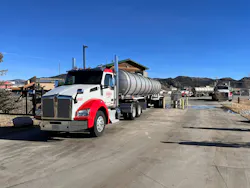
Recent fleet deployments show how fleets are applying AI to solve real business problems. Bulk carrier D.G. Coleman, which transports liquid and dry materials, encountered limitations from manual processes and disconnected systems. Dispatch decisions relied heavily on experience, with limited system support for evaluating current conditions. After digitizing workflows and introducing compatibility across loads, equipment and drivers, the fleet improved decision consistency, reduced errors, and accelerated billing and payroll.
For Odyssey Manufacturing, a chemical distribution fleet, the main challenge was data fragmentation. The data was spread across ERP systems, spreadsheets, and manual processes, creating delays and lower efficiencies. Uniting these systems delivered real-time visibility and allowed operational data to flow directly into decision-making, improving speed and equipment utilization.
In food-grade transport, Clasen Quality Chocolate needed to accurately manage tank washing, preloads, and product compatibility. Embedding these requirements into dispatch workflows improved coordination and reduced the risk of contamination, an area where errors are particularly costly.
These examples reveal a trend in technology adoption. Fleets are moving from systems that primarily record activity to systems that actively support decisions. That shift is where AI becomes practical, because it is applied at the point where work happens.
What fleets should consider
Successful implementation depends on more than just the technology itself.
Data integration is critical. Systems must be able to combine information from dispatch, telematics, maintenance, and financial platforms. Without that foundation, even the best tools will struggle to deliver reliable recommendations.
User adoption is equally important. Dispatchers and planners need systems that reflect how they work and support their decision-making process. Tools that operate outside of core workflows are less likely to be used.
Fleets should also take a focused approach. Starting with targeted use cases—such as dispatch planning or workflow automation—allows organizations to build momentum and expand over time.
Moving forward
Bulk fleets will adopt AI applications to solve practical and operational problems.
Fleets that focus on improving dispatch, decreasing errors, and increasing utilization will see the greatest benefit. By working with native AI platforms rather than those that layer AI on top of existing systems, they will be better positioned for lasting success.
About the Author
 Hans Galland
Hans Galland
Hans Galland is the CEO of BeyondTrucks, the provider of a platform for AI-powered truck dispatch planning and management in private fleets and carriers that provide specialized transportation services.