Digital disinfection: Odyssey Manufacturing cleans up dispatching
Odyssey Manufacturing, a leading supplier of technologically advanced disinfection solutions to the industrial, municipal, and pool industries in Florida, has doubled in size since Mark Lowenstine signed on as transportation manager in 2017. It now distributes over 200,000 gallons of high-strength sodium hypochlorite, or chlorine bleach, and other chemicals daily.
Yet Odyssey still used pressed wood pulp to manage its private fleet in 2025.
“Dispatching was the toughest job here,” Lowenstine reflected. “It’s seven days a week, and you’re taking orders and creating schedules on paper, converting it for accounting, and then coordinating every load. So we had trouble keeping dispatchers, and I knew it wasn’t sustainable, especially with the younger generation. Then we brought over Ferg [logistics coordinator Fergus Grogan], and he’s new-minded, but with the older generation’s fundamentals.
“That’s when I decided it was time to start looking for a transportation management systems [TMS].”
Lowenstine transitioned Odyssey’s 50 tank trucks to electronic logging devices (ELDs) soon after coming on board; and later upgraded to ELDs, cameras, and GPS tracking from Samsara, which he says is “fantastic,” so he wanted to work with another “cutting-edge” provider of transport technology. Then he read about a for-hire bulk hauler who went looking for the “Samsara of dispatching”—and said they found it in BeyondTrucks. “That is the quote that reeled me in because that’s what I was looking for,” Lowenstine said. What he discovered, after researching other providers and meeting with BeyondTrucks, was a modern, cloud-based solution positioned to grow alongside Odyssey, ensuring business continuity by preserving “tribal” knowledge, and arming Grogan with next-generation software capabilities.
“It’s a great tool,” Grogan said. “When you build loads in BeyondTrucks, you can see everything, and how one decision affects another, whereas before we were sorting through paper schedules.
“Now we can operate more efficiently through bigger-picture visibility.”
Grogan’s primary concern during the TMS selection process, which culminated with Odyssey signing with BeyondTrucks last spring, was securing digital resiliency in disruptive situations, like the consecutive hurricanes that hit Florida in 2024. But as they worked together toward full deployment in February, he grew to appreciate the platform’s ability to connect key departments, locations, and systems; and the BeyondTrucks team’s collaborative approach.
“What impressed me most was their responsiveness, and how easy it was to make the system fit our business,” Grogan said.
“They provided the blueprint and then let us run with it.”
Bridging the technology divide
A group of investors tapped Patrick Allman, a Navy veteran with a background in engineering, to start Odyssey in 1999. Under the leadership of Allman and later Marvin Rakes, Odyssey president, the company grew to include the distribution of multiple chemicals and related equipment; the longest-running “salt-to-bleach” plant in North America, the largest chemical railyard in the Southeast U.S.—both in Tampa—and four other Florida locations; and 95 employees, including 40 company drivers. To aid in the bulk distribution of its hazardous chemicals—UltraChlor is 12.5% sodium hypochlorite—Allman enlisted Lowenstine, who previously oversaw water and wastewater treatment for Polk County Utilities and now serves as Odyssey’s operations manager.
The company’s fleet includes leased Freightliner and Peterbilt daycabs with Paragon transfer equipment, Omni carbon fiber and TankCon FRP (fiberglass-reinforced plastic) tankers with specialized plumbing for proprietary products, stainless-steel Tremcar tanks for caustics, and Heil’s pneumatic dry bulkers for salt. With its own in-house transportation division, Odyssey can better control equipment availability, reliability, and customer service, but logistics management still is a relatively small portion of the overall operation. “We don’t have a large staff, so we don’t necessarily want a tremendous amount of data,” Lowenstine said. “We couldn’t analyze all of it.
“I just wanted something that made my dispatcher’s job easier.”
BeyondTrucks delivers there by combining API-assisted integrations, adaptable configurations, and sophisticated algorithms with a user-friendly interface that optimizes decision-making. And for Lowenstine, it’s also a cost-effective path to expedited efficiency gains, and a “data bridge” to future enhancement—long after he steps away. “I’m old school, but I’m smart enough to know you must embrace technology,” he said. “You have to find common ground with the younger people, and ways to motivate and help them succeed. Technology can do that.”
And developing and retaining talent is high priority for Lowenstine.
“Ferg is his designated successor, or protégé, so Mark’s doing everything he can to bring him along,” BeyondTrucks CEO Hans Galland observed.
“He’s a wonderful mentor within his organization.”
Real-time responsiveness
Grogan graduated from the University of Tampa in 2022. After studying marketing and management in school, he joined Odyssey’s accounting team in early 2023 and jumped at the chance to fill a logistics vacancy a year later. “It wasn’t a planned operation, but this company’s been good to me, they’re big on promoting from within, and I thought it would be exciting,” Grogan said. “The job definitely keeps you on your toes. There’s a new challenge every day.”
The newly promoted dispatcher assisted in Lowenstine’s TMS search and worked with BeyondTrucks’ implementation team, including Head of Carrier Success Natasha Martinez and Product Manager Karry Wang, to help them understand Odyssey’s operations and objectives. “We connected on multiple Zoom calls, and they flew in five or six times,” Grogan recalled. “They were there for us whenever we needed them.” He also took the lead on testing, working double time to pilot BeyondTrucks alongside Odyssey’s old paper processes.
“It wasn’t difficult, but it was time consuming,” Grogan acknowledged.
“We had to migrate our information to their site, and they had to learn what systems we were using.”
One of those systems is Acumatica, Odyssey’s new cloud-based enterprise resource planning software, which handles financials, and now is fully integrated with BeyondTrucks, streamlining the exchange of sensitive information—like unique bill-of-lading identifiers—between dispatching and accounting. “We used to go in and create everything in Acumatica, after making the paper schedule,” Lowenstine said. “Now we can do everything in BeyondTrucks.” The system also serves as a web-based repository for Odyssey procedures; supplementary details, like customers’ gate codes, order histories, and storage-tank levels; and mission-critical information that keep trucks moving in emergencies.
“We can’t be worried about how we’re going to respond to a crisis,” Grogan said. “We need to be ready to go.”
Quantifiable efficiency gains
For Galland, who teamed with COO Paul Xie to start BeyondTrucks in 2019, enhancing decision-making with real-time data is the primary objective, and their software is simply the vehicle for delivering optimization technology to their growing client base. “We didn’t set out to construct a TMS when we started this company,” Galland said. “But we quickly realized if you just give fleets an algorithm, or decision tool, you will not achieve full adoption.
“So, we had to expand the product and devise an interface that builds trust with the dispatcher, so they accept the recommendations.”
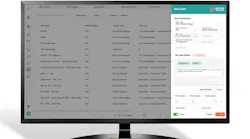

Grogan is taking them in. He already adjusted six long-established routes using BeyondTrucks’ visual dashboard, which consolidates operational intelligence in a user-friendly display. “No matter how much you can keep in your head, there’s a limit to the factors you’ll be able to consider on the front end, and more often than not, you’ll probably forget some small factor that might have influenced your decision,” Grogan said. “So, having all of this information handy, within two or three clicks, is invaluable.” Drivers are adapting to the app just as quickly, Grogan added—and the rewards are quantifiable, Galland insisted.
“In the bulk space, we typically see 15-20% gains in efficiency, and that represents a massive amount of value,” he said.
After initially targeting for-hire haulers in the mid-sized range, BeyondTrucks now is unlocking cost-savings and service-level improvements for private fleets, a segment that is still growing post-pandemic, according to the National Private Truck Council; but often is deficient in data standardization, Galland asserted. “We enable that process through our driver workflows, so that’s what private fleets are zeroing in on,” he relayed. “Yes, they can give shippers reliable capacity, but they still must justify to corporate why it’s important to own a fleet vs. using a common carrier.
“Optimization tools can strengthen that message.”
And, as a bonus, they eliminate piles of paper—which supports the C-suite’s ESG initiatives. “We’re happy with the way it works,” Lowenstine concluded. “Software isn’t cheap, but BeyondTrucks is a bargain.”
About the Author
 Jason McDaniel
Jason McDaniel
Jason McDaniel, based in the Houston TX area, has more than 20 years of experience as an award-winning journalist. He spent 15 writing and editing for daily newspapers, including the Houston Chronicle, and began covering the commercial vehicle industry in 2018. He was named editor of Bulk Transporter and Refrigerated Transporter magazines in July 2020.