Digital defense: NMFTA targets cyber threats and tanker recalls
Key Highlights
- NMFTA’s free Fleet Cyber Challenge offers seven tracks and 32 hands-on exercises involving commercial vehicle technologies.
- NMFTA researchers say Bendix EC80 safety recall software updates also remediate critical cybersecurity vulnerabilities.
- Tank trailers may be more susceptible to wireless attacks because their continuous metal shells can help carry radio-frequency signals.
- NMFTA urges fleets to apply EC80 updates promptly and is continuing tests to identify practical tanker mitigations.
- The organization’s broader security efforts include an AI governance framework, a threat-reporting portal, and a resilience guide for smaller fleets.

As modern commercial vehicles become increasingly interconnected, the tank truck industry is fighting a continuous battle to secure the digital networks that keep liquid freight moving.
To help fleet professionals proactively build their defensive skills, the National Motor Freight Traffic Association (NMFTA) recently launched an interactive cybersecurity challenge. And what serves as a virtual training ground for the sector’s cyber defenders arrives alongside an urgent, real-world warning for bulk haulers: a critical vulnerability in tractor-trailer braking systems continues to leave tank truck operators uniquely exposed to wireless hackers.
The organization’s inaugural Fleet Cyber Challenge provides a complimentary, online capture-the-flag (CTF) open lab where participants can investigate weaknesses in commercial vehicle technologies. This innovative educational push intersects with a fresh discovery by NMFTA researchers that recent Bendix EC80 safety recalls also remediate critical security flaws—a revelation that builds on the group’s ongoing investigations into tanker vulnerabilities.
“I’m excited about it because I’m a CTF addict, and it’s the way a lot of people get into cybersecurity,” Ben Gardiner, NMFTA’s senior cybersecurity research engineer, told Bulk Transporter.
“There’s a certain energy to it that really captures cybersecurity nerds.”
The fleet cyber challenge
The new platform features seven challenge tracks and 32 individual exercises covering threats to electronic logging devices, GPS spoofing, telematics, and vehicle communications. Designed for fleet IT teams, maintenance technicians, and security researchers, the online environment runs emulated versions of electronic control units rather than simple data simulations.
NMFTA’s expanding cybersecurity arsenal
The Fleet Cyber Challenge is part of a broader, multi-pronged effort by NMFTA to fortify the trucking and logistics sectors against a rising tide of digital threats. Recent initiatives include:
- Cybersecurity AI governance framework: Released in July 2026, this free resource provides 50 actionable controls across five domains to help fleets safely deploy Artificial Intelligence tools—from route optimization to back-office operations—without compromising sensitive data.
- Threat report portal: Launched in June 2026, this free collaborative portal enables organizations to anonymously report freight fraud, cargo crime, and cyber threats while gaining vital visibility into emerging security incidents across the transportation sector.
- Roadmap to resilience: Launched in March 2025, this guidebook specifically targets owner-operators and mid-sized fleets who lack massive IT budgets, offering practical strategies for network security, password hygiene, and incident recovery.
“What we want is an educational on-ramp so everybody on fleet ‘blue’ teams can get a grasp of the techniques. Not just the concepts, but the hands-on techniques you could use to both break and fix things,” Gardiner explained. “And that’s one of the great things about cybersecurity—to really be able secure something, you have to know how people are going to break in.”
That practical, hands-on experience is becoming increasingly critical as rigs grow more technologically complex.
“Today’s truck is essentially an office on wheels, with interconnected technologies supporting everything from vehicle operations to communications and freight movement,” Joe Ohr, NMFTA chief operations and technology officer, said in a news release. “With that connectivity comes cybersecurity risk. This challenge helps transportation professionals identify vulnerabilities, understand how systems can be exploited, and better protect the trucks and fleets that keep our supply chain moving.”
Tank trailers at risk
While the CTF challenge aims to build defensive skills across the industry, NMFTA is specifically alerting bulk haulers to a very real, immediate threat.
In 2023, NMFTA demonstrated how bad actors could use radio frequency-induced signals to hack into a tanker’s anti-lock braking system via the power line. At the time, tractor suppliers said brake controllers ignored these unauthorized commands. But the EC80 safety recall says otherwise, indicating a known software defect can cause the controller to incorrectly process signals under high electrical noise, potentially crashing the firmware and impacting braking performance.

“Shortly after that demo, we caught wind of the Bendix EC80 safety recall, and the recall language submitted by the OEMs and suppliers indicates the brake controllers were listening for commands and doing extensive processing.
“So we reverse engineered that vulnerability and discovered exactly what they were doing before the update.”
A security recall in disguise
The National Highway Traffic Safety Administration’s recall affects numerous heavy-duty truck manufacturers, including Peterbilt, Volvo, and International, covering EC80 ABS ECUs with Power Line Carrier trailer communication. NMFTA research confirms that these safety updates also address critical cybersecurity vulnerabilities that hackers could exploit wirelessly.
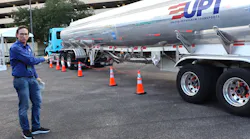
But while all commercial trailers run similar braking hardware, NMFTA found that tank trailers are more susceptible to wireless attacks due to their physical construction. Unlike a standard dry van—which is primarily built of fiberglass with metal confined to the edges or subframe—a tanker features a continuous metal shell. When a brake controller is installed, its ground is typically chassis-bonded directly to the trailer. So when attackers broadcast radio frequency signals, that metal shell acts as a big antenna, moving the signals across the ground plane. And because the brake controller reads voltage as a difference, or delta, the fluctuation effectively induces the malicious command into the braking system.
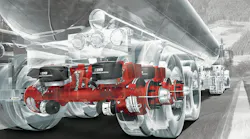

“It’s very important for bulk haulers to complete that EC80 safety recall on all of their tractors, because that recall also remediates security issues,” Gardiner stressed. “What we discovered is really unfortunate—that the most susceptible equipment is the equipment that also hauls the most hazardous materials.”
Next steps for fleets
Gardiner urges carriers to apply the Bendix software updates immediately using the standalone utility provided to dealers and fleets.
In the meantime, fleet IT staff and technicians can sharpen their defensive skills by registering for the Fleet Cyber Challenge. And NMFTA is continuing to research mitigations specifically for tankers, recently conducting rolling tests at a former Air Force base in Rome, New York.
“We think there’s a way to mitigate these wireless attacks based on the results we had in those tests,” Gardiner said. “And if anyone is willing to host us, we would love to go to their site to continue testing and really zero in on how we can protect tankers in a way fleets could easily deploy.”
About the Author
 Jason McDaniel
Jason McDaniel, based in the Houston TX area, has more than 20 years of experience as an award-winning journalist. He spent 15 writing and editing for daily newspapers, including the Houston Chronicle, and began covering the commercial vehicle industry in 2018. He was named editor of Bulk Transporter and Refrigerated Transporter magazines in July 2020.