Zero errors, faster loads: Tandem Concepts digitizes the fuel rack
The concept isn’t complicated.
Connecting loading racks with fuel haulers via seamless, end-to-end digital communications will reduce errors, increase truck throughput, boost safety, and optimize activities for everyone involved.
The execution is far more complex. The U.S. fuel supply chain—one of the world’s largest and most essential networks—is exceedingly convoluted. Various economic factors and strategic shifts have sparked myriad mergers, acquisitions, and divestments over the last 100 years, leaving legacy producers, refiners, storers, transporters, and retailers segmented into streaming silos; and multiple buyers, sellers, traders, and marketers exchange their bulk liquid commodities between initial exploration and end-user consumption.
“There is a great deal of complexity associated with how the market works here in the United States,” confirmed Ken Evans, general manager of energy and refined fuels at DTN, a global data and technology firm that serves energy, agriculture, and weather-driven industries. “That’s why we feel strongly—across all the markets we serve—that trusted intermediaries are needed to bring cohesive insights to every stakeholder,” added Doug Bennett, DTN chief growth officer. “A walled garden cannot fully serve this elaborate many-to-many ecosystem.”
Fortunately, Tandem Concepts is on the case.

The Charleston, South Carolina-based software startup led by charismatic CEO Drew Stypa and systems-savvy Chief Technology Officer Will White is working hard to modernize archaic processes and bridge the digital divide that isolates tank truck carriers and fleets from their distribution partners in an endeavor that ultimately promises to inject previously unrealized value into the entire fuel supply chain—and their advocates hail from across this vital industry. Bulk Transporter surveyed 18 decision-makers across 11 participants, including some of the largest storage terminal operators, transporters, retailers, and loading rack technology providers in the country; and all agreed a solution to this long-standing problem is past overdue, and Tandem Concepts might be the firm that finally delivers.
“Their approach just makes sense,” insisted Steven Straight, senior manager of terminal customer services at Buckeye, which moves 2 million barrels of refined fuels across 130 petroleum product terminals every day. “And Drew’s done a great job of going out there and being evangelical, and his message is resonating because our supply chain partners recognize the problem, and there is a solution.”
Informed fuel haulers are especially enthusiastic—and no group is more excited than professional drivers.
“This system is a time-saving tool that’s revolutionizing order-based processing and improving my efficiency,” said David Milligan, a certified driver trainer with Eagle Transport Corporation, one of Tandem Concepts’ original launch partners. “I love that it helps prevent mispulls and allocation selection. I simply input minimum info, and all the details are locked in from dispatch.
“Everything you need to know is at your fingertips.”
Toiling in tandem
Stypa was working at World Fuel Services when inspiration struck during a visit to a wholesale customer’s fuel terminal. A driver with a long list of order details and a broken trailer probe “fat-fingered” one button on the tiny keypad—and fuel gushed out of the overfilled tank. “I started pulling on the strings and realizing how much of a ripple effect manual entry errors have on the supply chain,” he recalled. “At the highest level, there are up to 50 million annual transactions in one of the world’s largest supply chains, and there’s still no digital order communications between carriers and terminals. That’s what we’re trying to solve for.”
See also: Tandem Concepts joins DTN
He met his future business partner at the Dinghy Dock bar on Saint Martin, where White retreated to escape the long hours in his cramped New York apartment while working for Peloton during the Covid-19 lockdown. “We instantly became friends, probably because we were two of the more rational people on the island, both trying to work remotely,” White recalled. “And as he was telling me about this idea he was tinkering with, I thought, ‘This is crazy. That’s exactly what I do.’
“It’s data and software engineering, and logistics integration, and, at the time, I was combining Peloton’s systems with third parties like XPO and JB Hunt.”
The duo officially joined forces and commenced development of their fleet-focused approach to order-based loading in 2021—just as artificial-intelligence applications were advancing exponentially. Their now AI-powered, fully encrypted software-as-a-service (SaaS) uses anonymized prompts to validate carrier authorizations and driver credentials, check load allocations, and pre-populate product details before the truck reaches the rack. And the first “sandbox” test with one of the largest tank truck carriers in North America confirmed the system’s utility.
Tandem generated 40 electronic bills of lading and compared them to drivers’ manually entered information. All of Tandem’s were correct. Six of theirs were not—all due to process error. “They said, if we’d put this in the system, every order would have been right,” White relayed.
“That was one of the best moments of my career.”
Storage and distribution
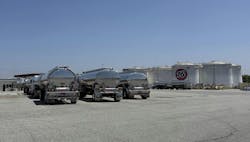
Loading racks are not the highest-margin points in the trillion-dollar oil-and-gas value chain, so many competitors are indifferent to innovation in the space, Bennett suggested. But terminals that adopt Tandem-enabled techniques stand to gain as much as transporters. Decisionmakers with Buckeye, Phillips 66, and Global Partners indicated operators who tackle at-rack issues can alleviate lane congestion—thus boosting product throughput—decrease demurrage paid to detained haulers, and reduce rebates for redirected trucks.
Global helped Tandem fine-tune its disruptive technology; and teamed with Eagle and Toptech Systems for the first real-world deployment in Apex, North Carolina, in 2024. “Compared to the vendors I was talking to, the ideas were more real, and the conversations were more productive,” said Bill Cashin, vice president of technology for Global’s 54 U.S. terminals. “We were thinking the same things.” The company now is utilizing Tandem’s system at 11 terminals—with eye-opening, efficiency-boosting results. “I’m surprised more operators aren’t trying this solution,” Cashin said. “It’s not complicated, so most could manage the change.”
See also: Trimble reveals Tandem partnership
Phillips 66, which runs 30 truck-rack terminals, this year turned on 10 Tandem sites—following a 2023 test—and it planned to add two more in the fourth quarter. “We want to stay on the cutting edge of midstream innovation,” emphasized Aaron Marcynuk, Phillips 66 new technologies director. “We also want to be good business partners, so carrier relationships are important to us.”
Tandem now is live at Buckeye’s two Knoxville, Tennessee, facilities after clearing a recent pilot, and Buckeye is exploring a more comprehensive rollout as part of a larger initiative to overhaul loading-rack technology and equipment across its network. But, like other players in the segment, it needs more transporters to request the service to help propel proliferation that creates consequential scale. “While we’re currently navigating a range of technical service enhancements and offerings that would ensure a thoughtful and scalable rollout of Tandem, we remain optimistic that partnering with Tandem is not a question of if, but when,” Straight said.
“We’re highly motivated to accelerate this collaboration so the entire ecosystem can realize the benefits.”
Private and for-hire transportation
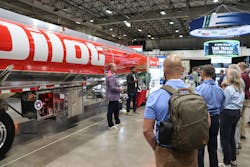
Tandem Concepts’ presentation during National Tank Truck Carriers’ 2025 Annual Conference in Tampa, Florida, was met with considerable excitement from carrier and fleet representatives in the room, as well as Patrick Usher, Usher Transport EVP of corporate governance and NTTC Energy Services Committee chairman, with all agreeing Tandem’s platform can improve operational efficiency, driver satisfaction, and roadway and retail station safety.
Eagle reported executing “hundreds” of loading-rack transactions within the first few months of activating Tandem. “One aspect that stands out to us is the seamless integration between our system and the loading facility,” said Mike Stevens, Eagle district manager. “It’s no secret that many loading errors occur at the terminal. With Tandem, we can effectively eliminate mistakes such as incorrect products, destinations, or customers. This streamlined process ensures that our loading operations run smoothly and accurately. Drew and Will were instrumental in getting us up and running.
“We eagerly anticipate Tandem’s expansion to more facilities in the future.”
SWTO, a private fleet that serves more than 1,500 7-Eleven, Speedway, and Stripes convenience stores, recently executed its first deployment in Lubbock, Texas, in partnership with Phillips 66. Archie Wood, director of transport operations for SWTO’s fleet of 225 trucks and 250 tankers—which he expects to haul 2.3 billion gallons of fuel in 2025—plans to roll out Tandem across SWTO’s network as the system spreads, citing a three-fold value proposition of forward-looking product availability, simplified loading experience, and real-time data as compelling capabilities that are easily configured “behind the scenes.”
“Once loading is complete, electronic bill-of-lading (BOL) data is immediately available and includes the [transportation management system] load number,” Wood said. “We’re working to add store/destination numbers to the BOL and integrate this data into our system, eliminating manual data entry and supporting the industry’s shift toward electronic shipping documents.”
Electronic BOLs keep drivers from pulling off the roadway to add load details to their electronic logging devices, and speed up reconciliation so fleets can get paid faster. Those are key motivators for planned launches by for-hire carriers Groendyke Transport, Penn Tank Lines, and United Petroleum Transports. “We’re currently upgrading our operating system and expect to begin testing Tandem Concepts in early 2026,” said Matt Herndon, president and CEO of UPT, which, along with sister company Florida Rock & Tank Lines, runs a fleet of 800 trucks and 1,000 tankers that put more than 13 million gallons of fuel in the ground every 24 hours.
Additionally, Pilot Company, which serves more than 900 travel centers across North America, and CLI Transport, which serves 815 Sheetz convenience stores, are evaluating the system, and particularly interested in preventing loading errors that can lead to cascading safety and accounting issues, and ensuring compliance with environmental regulations.
“I’ve talked to carriers who have conducted thousands of transactions with zero errors using this system,” shared David Overton, Pilot senior director of logistics, who manages over 3,000 pieces of equipment used to supply the largest fuel retailer in the U.S. “So, I have no doubt this could benefit our industry.
“The question is how quickly does it scale to the market?”

Software and hardware
Technology partners like Toptech and DTN, who provide fuel terminal software and hardware, are helping Tandem upscale its solution through integrations with leading transportation management platforms, including Gravitate and Trimble’s TMW.
Toptech provides the load-rack controllers, including its Multiload II+ system, drivers interact with at a majority of terminals in the U.S. and abroad; and it’s working with Tandem to incorporate Tandem’s technology into its Load2day SaaS, and TMS6 and TMS7 terminal management systems. “It’s an add-on solution for Load2day customers that allows them to take advantage of order-based loading without the overhead, which is handled by the carrier,” said Manish Patel, Toptech VP of technology. “By leveraging the Tandem Concepts solutions, terminal operators realize all the benefits without any negative impacts to fuel owners.
“They simply enjoy the positive effects of added value at their facilities.”
See also: Tandem launches fuel loading system
DTN’s offerings include its Guardian3 terminal automation hardware, TABS (Terminal Allocation and Billing System) software, “decision-grade” data intelligence on road and weather conditions, and integrations with leading business management software providers like SAP (which offers ERP and CRM systems) and price reporting agencies like OPIS—all of which DTN aims to combine in a fuel operations hub that leverages Tandem’s transformative connectivity.
“I’ve been waiting 30 years for someone to crack this nut, so kudos to Tandem for identifying the problem, taking it on, and asking, ‘Where can I make a difference in this industry?’” said Eamonn Clarke, CLI director of petroleum distribution, whose fleet of 280 tank trucks visits more than 100 different terminal racks and transports over 2 billion gallons of fuel annually.
A fully connected future
Tandem secured over 50,000 error-free loads—representing over 350 million gallons of petroleum products—through the first nine months of 2025, Stypa said, and he and White already are planning their next moves, including rolling out retail-specific programming and enabling rack reservations that guarantee allocations—the holy grail for U.S. fuel transporters.
“Drew and Will do great work,” Marcynuk said. “If it’s possible, they can do it.”
Everyone Bulk Transporter consulted agreed allocation reservations are the most complicated capability to deliver upon, but they’re already available in Europe, Bennett said; and they’re possible here, too—and sooner than people might think—if all the vested parties unite.
“I’d hedge longer, but that depends on who gets a taste of it,” predicted Craig Yocham, Global SVP of terminals. “If the right customers ask for it in the next six months, you could compress that timing down to a year, because then you would be meeting real-world demands.
“Right now, we’re still cranking out the appetite.”
A fully optimized fuel supply ecosystem decreases friction at both ends, allowing transporters to increase equipment utilization and terminal operators to reduce stocks by aligning allocations with tank inventories—capacities everyone can appreciate in a challenging economy.
But nothing is possible without first modernizing rack communications.
“I can’t be convinced that it’s a bad idea to digitally connect carriers and terminals, because this is probably the biggest logistics network in North America outside of Amazon, FedEx, and UPS,” White said.
“It’s such a common-sense solution.”
About the Author
 Jason McDaniel
Jason McDaniel
Jason McDaniel, based in the Houston TX area, has more than 20 years of experience as an award-winning journalist. He spent 15 writing and editing for daily newspapers, including the Houston Chronicle, and began covering the commercial vehicle industry in 2018. He was named editor of Bulk Transporter and Refrigerated Transporter magazines in July 2020.