Safety tech and streamlined rules: Roundup of recent FMCSA actions
Key Highlights
- Liberty Bulk Transport is seeking the ninth FMCSA Intellistop exemption for use across its fuel-hauling fleet.
- Experts praise the pulsating brake lamp technology for its ability to mitigate rear-end collisions and save lives.
- Grote Industries is requesting a second exemption to operate flashing auxiliary lamps that improve safety.
- FMCSA rescinded the requirement for rear impact guard labels, eliminating the possibility of citations for illegible markings.
- A new final rule adds an exception for small auxiliary fuel tanks in response to a TTMA petition.
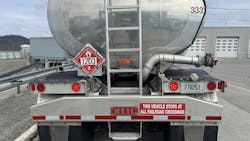
The Federal Motor Carrier Safety Administration has granted eight exemptions for Intellistop’s pulsating brake lamp module to motor carriers. Liberty Bulk Transport aims to secure the ninth.
The Louisville, Kentucky-based fuel hauler formally applied for the five-year exemption from Section 393.2S(e) of the Federal Motor Carrier Safety Regulations—which requires all exterior lamps to be “steady burning”—in December. FMCSA posted the exemption request Feb. 10 and is accepting comments through March 12. The agency had received three comments as of Feb. 25—two in favor of and one against granting the parts-and-accessories exception, which seeks to mitigate the rear-end collisions frequently caused by distracted drivers.
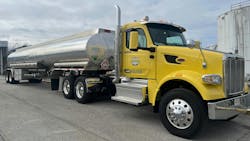
Liberty, which delivers gasoline, diesel, and jet fuel in five states with a fleet of 80 tank trucks, already is using Intellistop’s module to pulse a center-mounted auxiliary brake lamp under National Tank Truck Carriers’ similar FMCSA exemption. But Darren Lloyd, Liberty compliance and equipment manager, is seeking his own exemption to further protect against citations, and says he prefers Intellistop’s solution over other options because of its ease of use. “We’ve always had the third brake light on our trailers, in the ladder, but it was just solid,” Lloyd told Bulk Transporter. “So, we utilize Intellistop solely for that third brake light, so that it flashes four times and then goes solid, which is also covered by the NTTC exemption.
“What I’ve noticed driving down the road is there are so many different solutions for commercial vehicle tail lights, and with LEDs you get different intensities, so with some of them, when they hit the brakes, you can’t even tell the brakes are on. What I like about this solution is it immediately captures your attention, and you know something is slowing down in front of you. There is another solution that flashes yellow and then turns red. But if I see flashing yellow, I’m like, ‘What’s going on?’ and it takes me a second to figure out they’re just braking. That’s confusing. But anyone who’s following a tractor-trailer and sees four red flashes and then a solid light instinctively knows the vehicle is slowing down, and they need to as well.
“It reduces the risk of people falling into a trance behind a truck.”
 www
www coffeyville_resources_truck
The Intellistop module currently is installed on about 90% of Liberty’s tankers. If the exemption is granted, Lloyd plans to equip the rest of Liberty’s fleet, and then carry over the technology to parent company Prospect Transportation, a New Jersey-based fuel hauler with 100 trucks.
Lloyd has plenty of support in this endeavor, too.
In addition to the two positive public comments, his LinkedIn post about filing the exemption request drew praise from across the industry, including comments from Todd Catoe, an executive officer with the South Carolina State Transport Police, and Jack Van Steenburg—the former FMCSA assistant administrator and chief safety officer who retired in 2024. “I believe this product can be a lifesaver, prevent injury, and property-damage accidents,” Van Steenburg wrote. “Too many crashes occur when a car hits the back of a commercial motor vehicle. Look at FMCSA’s crash preventability data … the overwhelming request to determine non-preventability was from cars/trucks striking the rear of a CMV, almost 23,000 instances out of about 65,000 submitted. There are other reports stating that 300 people are killed and thousands injured yearly because they struck the back of a large truck.
“FMCSA and NHTSA had a chance to approve the Intellistop device for all motor carriers back in 2022 but relied on outdated research and an antiquated set of FMVSSs [Federal Motor Vehicle Safety Standards]. I say the administration must allow a potential life-saving device.
“What do they have to lose? Oh yeah, another life!”
Grote seeks second exemption
Grote Industries is seeking a second five-year exemption from the steady-burning requirement. This one would allow carriers to operate commercial vehicles equipped with auxiliary rear or side lamps that flash or strobe when controlled by Grote’s rear-end collision warning system.
FMCSA posted the exemption application notice Feb. 9 and is accepting comments through March 11. The agency had received three comments as of Feb. 25—one in favor of the exemption, one against it, and one from the Commercial Vehicle Safety Alliance seeking a 60-day extension of the comment period. “In the request, Grote bases much of their justification for the exemption on the performance and efficacy of forward collision warning [FCW] technology,” wrote Collin Moody, CVSA executive director. “However, the proposed technology, while based on FCW, does not operate in the same manner and the documented safety performance of that proven technology cannot simply be assumed to apply to this new application.


“While CVSA has a long-standing history of robust support for deployment of safety technologies that reduce or mitigate the severity of collisions involving CMVs, that support is based on the technology being proven to improve safety through thorough research and testing. CVSA requests an extension to the comment period to allow our membership to discuss the proposed exemption request. The Alliance’s 2026 Workshop is scheduled for April 19-23 and will include meetings of our Vehicle, Policy and Regulatory Affairs, and Crash Data and Investigation Standards Committees. The workshop brings together hundreds of safety professionals from enforcement and industry to discuss topics such as this, and an extension of 60 days would allow our members to consider the exemption fully and provide thoughtful feedback to the agency.”
FMCSA renewed Grote’s exemption that allows carriers to use its amber brake-activated auxiliary pulsating lamp on the rear of their commercial motor vehicles—in addition to the steady-burning brake lamps required by the FMCSRs—in November 2025. Grote secured the initial exemption in 2020.
FMCSA eliminates labeling requirement
FMCSA rescinded the requirement that rear impact guards are permanently marked or labeled with a certification from the impact guard manufacturer in a final rule posted Feb. 19. The revision takes effect March 23.
The final rule amends 49 CFR Part 393.86 to remove the rear impact guard certification-label requirement, which has “proven problematic” for many carriers because the label often becomes illegible during the service life of a trailer, exposing them to citations despite the guards still meeting performance standards. “This final rule eliminates an unintended regulatory burden on motor carriers without compromising safety, as it does not affect the applicable FMVSS,” FMCSA said. “The final rule also rescinds a guidance document pertaining to illegible, incomplete, or missing rear impact guard certification labels.”
NTTC commended the agency’s decision, saying “once installed and maintained, the structural safety of the rear impact guard is best demonstrated through physical condition, rather than a faded or missing label.” The association also joined other industry stakeholders in supporting the action through its comments on the proposed rule, writing in July 2025 “NTTC believes rear impact guards are critical for the safe operation of tank trucks, and wholeheartedly supports their inclusion of items needed for routine inspection. However, tank truck carriers have indicated they are unable to have manufacturers reproduce missing or damaged labels, resulting in unpreventable and unjustified violations of 49 CFR 393.86.
“NTTC is grateful for FMCSA’s commitment to reduce this regulatory burden on carriers without compromising safety.”
TTMA secures standards revision
In response to a petition for rulemaking by the Truck Trailer Manufacturers Association, FMCSA amended its fuel tank requirements to add an exception to the prohibition on gravity and syphon feeds for auxiliary pumps with a nominal fuel tank capacity of not more than 5 gallons mounted on the trailer chassis frame or trailer bed, for purposes other than operation of the motor vehicle, that are operated only when the motor vehicle is not in motion.
The final rule takes effect March 23.
“This change will have no impact on safety,” FMCSA stated. “The prohibition against gravity or syphon feeds is primarily intended to prevent the continuous fueling of any fires that may occur. The exception only applies when the vehicle is not in motion and only for fuel tanks with a nominal capacity of not more than 5 gallons, mounted on the trailer chassis frame or trailer, when the risk of fire is mitigated. The final rule will result in cost savings for owners of eligible auxiliary pumps by eliminating the need to invest in upgrades to comply with the current requirement.”
About the Author
 Jason McDaniel
Jason McDaniel
Jason McDaniel, based in the Houston TX area, has more than 20 years of experience as an award-winning journalist. He spent 15 writing and editing for daily newspapers, including the Houston Chronicle, and began covering the commercial vehicle industry in 2018. He was named editor of Bulk Transporter and Refrigerated Transporter magazines in July 2020.