Report: High diesel to squeeze tank truckers until summer 2027
Key Highlights
- Diesel prices are expected to remain above $5 per gallon until at least July 2027, driven by multiple global supply shocks and low U.S. distillate stocks.
- The recent surge has increased fuel costs by over 80% since January, squeezing profit margins for trucking fleets, especially those without fuel surcharge protections.
- Global events such as conflicts in the Middle East and drone strikes on Russian refineries are disrupting crude and diesel supplies, contributing to record-high prices.
- Operational strategies like adjusting pricing, enforcing speed limits, securing fuel assets, and strategic fueling are essential for fleets to survive prolonged high diesel prices.
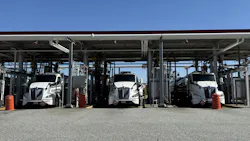
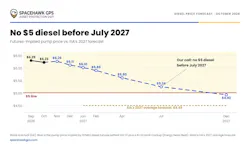
The U.S. diesel average is projected to stay above $5 a gallon until at least July 2027, according to a new market analysis that defies more optimistic government forecasts.
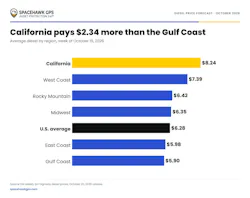
With the national average recently hitting $6.28 a gallon—and California peaking at $8.24—the prolonged price surge is putting intense financial pressure on trucking fleets, particularly those hauling liquid bulk. The forecast comes from SpaceHawk GPS and GPS Tracker Shop, a fleet technology and asset protection firm based in Murrieta, California, which recently analyzed the collision of global supply shocks and empty domestic storage tanks driving the current market.
“Tank carriers get squeezed from both ends,” Ryan Horban, president of marketing at GPS Tracker Shop, told Bulk Transporter. “They haul the diesel the country is running short on. Then they burn that same fuel, at over $6 a gallon, to make the delivery. U.S. distillate stocks just hit their lowest mid-October level since EIA started weekly records in 1982.
“Budget 2027 off EIA’s $4.49 forecast and you’ll come up short by spring.”
Margins evaporating
The cost of diesel has risen 80% since January, jumping from $3.48 to well over $6 by mid-October. For heavy-duty operations, a semi-tractor getting 6.5 miles per gallon and running 60,000 miles a year is now burning roughly $24,500 more in fuel annually compared to last year, according to the SpaceHawk report.
For tank truck operations already running tight margins, the sudden and sustained jump in fuel expenses is outpacing standard recovery methods. However, the severity of these price spikes differs depending on contract structures. While larger carriers typically have fuel surcharges built into long-term contracts with shippers to help mitigate volatility, many smaller trucking companies, owner-operators, and fleets reliant on freight brokers often operate on “all-in” spot rates without guaranteed offsets.
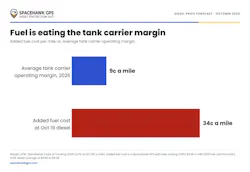
“The math is ugly,” Horban explained. “ATRI puts the average tank carrier’s operating margin at 4% last year, about 9 cents a mile. Fuel now costs roughly 34 cents a mile more than the 2025 average. Surcharges recover some of that, but they trail the pump. So a carrier can run a tight operation and still watch the margin disappear between surcharge updates.”
Three fires under the pump
The newly released SpaceHawk Diesel Price Forecast report for October outlines why prices are stuck at near-record highs. Rather than a single issue, the market is currently battling three separate supply shocks simultaneously:
- The Iran War and Strait of Hormuz: With ongoing shipping attacks in the Gulf, Middle East crude shut-ins remain significant, and oil flows are expected to stay limited through the end of the year.
- Ukraine’s drone strikes on Russia: Drones have successfully targeted Russian refineries that typically produce half of the country’s diesel, nearly halting seaborne exports. Empty U.S. tanks: U.S. distillate stocks fell to 105.1 million barrels in early October, 11% under the five-year average, leaving the country with just 28 days of supply on hand.
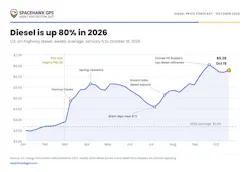
While the U.S. Energy Information Administration predicts a slide to a $4.49 average next year, the SpaceHawk report takes a firmer stance on the long-term reality for fleets.
“We’re calling it. The U.S. diesel average stays above $5 a gallon until at least July 2027,” the report states. “EIA’s forecast averages $4.49 for next year. We think that’s too hopeful, and the market’s own money backs us up.”
Plugging the leaks
Because carriers cannot control the global cost of crude, mitigating the impact requires locking down internal inefficiencies and preventing theft. Lead-foot driving alone can cut highway fuel economy by 15% to 30%, while unplanned miles and unauthorized trips burn $6 diesel that is never billed to a customer.
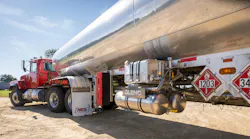

Additionally, with fuel prices so high, diesel theft has become a growing concern for parked trailers and equipment.
“A GPS tracker won’t lower your fuel bill,” Horban noted. “What a tracker does is show every mile a truck drove and why. Out-of-route trips, a tractor running errands after hours, a driver doing side work in your work vehicles. All of that shows up in the trip history. Thieves have noticed diesel prices, too. Sheriffs near the Alabama and Florida line are already chasing fuel drained from farm equipment.
“Put a real time GPS tracker on a parked tank trailer, and you get an alert the second the trailer moves when nobody should be moving it.”
To survive the sustained high prices, the report recommends carriers take several actions:
- Reprice quotes and surcharges: Ensure bids reflect today's $6.28 reality, not last year’s averages.
- Adjust budgets: Plan for $6 diesel through the winter and $5.50 in the spring. Stress-test the business at $6.75.
- Utilize speed alerts: Correcting hard driving habits can immediately save fuel.
- Lock down after-hours assets: Secure fuel pumps and set after-hours movement alerts on equipment.
- Strategic fueling: With massive regional price disparities—such as the Gulf Coast running over $2 cheaper than California—carriers must plan fuel stops deliberately and verify compliance.
About the Author
 Jason McDaniel
Jason McDaniel, based in the Houston TX area, has more than 20 years of experience as an award-winning journalist. He spent 15 writing and editing for daily newspapers, including the Houston Chronicle, and began covering the commercial vehicle industry in 2018. He was named editor of Bulk Transporter and Refrigerated Transporter magazines in July 2020.