Automated accuracy: Blend reimagines delivery-point dosing
Key Highlights
- The system automates fuel additive dosing, eliminating manual handling and reducing safety risks for drivers.
- Constructed primarily from aluminum, Blend is lightweight, durable, and capable of operating reliably in extreme cold conditions.
- Installation is quick, taking approximately six to eight hours for retrofits, with ongoing efforts to expand dealer and installer networks.
- The system leverages proven industry components, including Dixon couplers and P.S.I. control units, ensuring compatibility and reliability.
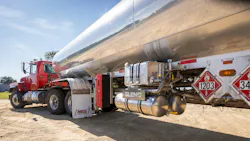
OKLAHOMA CITY—The era of drivers manually measuring, handling, and pouring fuel additives at retail stations is on notice.
Harvard, Illinois-based Blend System, in partnership with AlumiTank, introduced Blend, the first automated pneumatic dosing system engineered for fuel tankers, at National Tank Truck Carriers’ Tank Truck Week 2026. “When you look at the system today, you might think it was a piece of cake,” David Kirkpatrick, Blend founder and AlumiTank executive director, told Bulk Transporter.
“But we tried skinning that cat so many different ways before arriving here.”
The innovative, patent-pending, closed-loop system grew out of operational challenges identified by Casey’s, which sought a better way to manage diesel additives in select markets where winter conditions make consistent fuel treatment vital, the company explained.
“At Casey’s, we are always looking for innovative ways to improve our operations and make the work safer for our team,” Nathaniel Doddridge, senior vice president of fuel operations at Casey’s, said in a news release. “We saw an opportunity to improve a difficult, manual process and brought that challenge to AlumiTank. They became an important partner, listening to our drivers, testing the system alongside us and continuing to refine it until we had a solution that gives us greater consistency and confidence in how our diesel is treated.”
Traditionally, fuel haulers rely on “splash” blending at the delivery point, but Casey’s wanted to guarantee the precise formulation of its performance blends upon arrival. “Most blending is done at the loading rack, but when you have your own blends, or anti-gel or lubricity additives, it’s easier to control that yourself, rather than doing it at the rack,” said Keith Lamfers, the transportation safety manager at Casey’s—and newly named national chair of NTTC’s Safety and Security Council.
Another key driver for Casey’s was implementing a safer system for drivers to blend products as they drop them in, reducing the risks associated with climbing on tankers or directly handling chemicals.
“We want to make the job safer for our drivers,” Lamfers said.
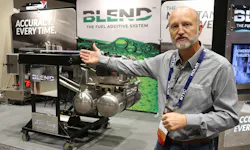
Overcoming development hurdles
The road to an automated dosing system was paved with more than two years of trial and error, Kirkpatrick said, noting that his team overcame numerous challenges primarily driven by harsh chemicals degrading the testing equipment.
“We tried electric and pneumatic pumps,” he said. “They would move the product for a period of time, until the impellers were gone, because the additives dissolved the materials they were made from.” Solvents ate through brass, buna O-rings, and traditional hoses, forcing the engineering team to abandon metering pumps. Ultimately, Blend succeeded by simplifying the design and using only 50-series aluminum, stainless steel, and Viton components.
Capabilities, treat rates, and precision
The resulting system relies on the tractor’s air supply and trailer’s electrical system, requiring no auxiliary compressor or separate battery. And the unit will perform reliably in extreme environments, including freezing midwestern winters with heavy snow and sub-zero temperatures, Kirkpatrick said.
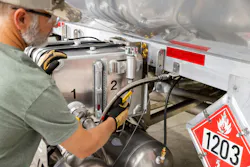
Blend allows drivers to meter the required additive using a graduated sight window, connect the injection coupler, and activate the unit before the additive is automatically blended into the fuel stream during discharge. The process enables the driver to dispense the precise dose in under three minutes.
It can be configured for common treat rates, including 1:1,000 and 2:1,000, as well as custom rates. During extensive testing over 15 months in selected Casey’s markets, Blend completed more than 350 validated loads—and treated more than 2.7 million gallons of fuel with a 100% exact treat rate and zero reportable spills.
Installation and weight
Constructing the system largely out of aluminum—a core competency of AlumiTank, Blend’s manufacturing partner and sister operation—kept the overall weight manageable, Kirkpatrick reported. He estimated that, if the system was built from steel, it would weigh three times as much. The primary three-tank assembly, mounted on the driver’s side of the trailer, weighs approximately 130 pounds dry, and the total system adds about 150 pounds. For Casey’s, Blend adds a 15-gallon additive tank for double-dosing a full 7,500-gallon load in extreme cold.
The system can be retrofitted onto compatible trailers by a certified installer in approximately six to eight hours or integrated into new tankers in production, Kirkpatrick said. Currently, Blend is building out a network of certified dealers and installers, and their technicians provide hands-on training to ensure the unit is properly integrated into the trailer’s frame rails, pneumatics, and electrical systems.
Industry partnerships and market penetration
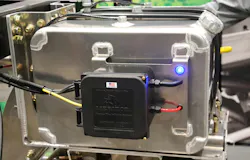
The dosing system utilizes established, proven components from reputable industry partners. The unit leverages Dixon Valve dry break couplers for the unloading connection, and a control unit from Pressure Systems International (P.S.I.) and Meritor for innovative pneumatics management. In fact, Jim Herzog, P.S.I.’s regional sales director who attended Tank Truck Week, said he’d never seen this particular use for the control box—and was notably impressed by the ingenuity.
Presently, Casey’s is the exclusive user of the system, with 18 units deployed in the Rockford, Illinois, region, and another two recent installations completed on new Heil tank trailers by a dealer in St. Louis. “Casey’s primarily runs Heil units, but we’ve also done a couple of MAC trailers. The system is agnostic, so it’s meant to provide a universal solution whether you run Polar products, Tremcar trailers, or any other manufacturer’s products.
“That’s the objective as we continue to grow the organization.”
Blend is actively filling its supply chain pipeline and ramping up production capacity, Kirkpatrick shared. He anticipates new customers could have units on their trailers by the end of 2026.
Safety comes first
The closed-loop system promises to boost fuel delivery accuracy, consistency, and efficiency—all clear operational benefits, Kirkpatrick concluded.
But improving safety is the top priority for Casey’s and Blend System.
“I have 90 employees,” Kirkpatrick said. “We have a tremendous amount of tenure, and I love my people. I care for them tremendously. The last thing I want is for them to get hurt or injured. So they learn to appreciate what we’re dealing with from a chemical standpoint. Casey’s is in the same boat. They want to keep their drivers safe.
“So safety was paramount in the development of this system.”
About the Author
 Jason McDaniel
Jason McDaniel
Jason McDaniel, based in the Houston TX area, has more than 20 years of experience as an award-winning journalist. He spent 15 writing and editing for daily newspapers, including the Houston Chronicle, and began covering the commercial vehicle industry in 2018. He was named editor of Bulk Transporter and Refrigerated Transporter magazines in July 2020.