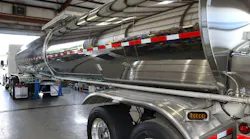
TTW panel: Spec’ing tank trailers for versatile operations
Key Highlights
- Start with the commodities, payload targets, permits and temperature needs to build a versatile trailer spec.
- 2205 lean duplex steel can improve corrosion resistance and save up to 800 lbs., but it requires proper tank-wash temperatures.
- Protect wiring from road salt and moisture with sound repair practices, and ensure circuits can handle electrical surges.
- Review specs and drawings before production, then inspect a pilot unit to catch maintenance and component-placement issues.
- Train drivers and technicians to use new features, and involve suppliers in hands-on instruction.
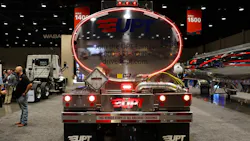
OKLAHOMA CITY—Maxing out a tank trailer’s lifespan requires fleet managers to look beyond the initial purchase price. Because the true cost of ownership hinges on balancing advanced metallurgy, weight-saving specs, and component durability against years of harsh road realities.
During the “Tank Spec’ing 101: Build the Best Trailer for Your Operation” panel at Tank Truck Week 2026, equipment experts mapped out the delicate balance between upfront capital investments and long-term TCO. Moderated by Taylor Craigen, The Jack Olsta Company vice president, the discussion featured Tim Gallagher, United Petroleum Transports VP of maintenance; Adam Quinn, Wabash senior director of tank trailers sales; and Al Anderson, Peterson Manufacturing VP of sales and marketing. The group stressed that a successful specification process must account for hardware reliability, supply chain constraints, maintenance simplicity, and future hauling opportunities—before the manufacturer begins production.
“We have to ask a lot of spec’ing questions on the operational side: What are our commitments currently, and what could we potentially be looking at on the horizon?” Gallagher said. “Can you diversify while spec’ing that equipment? And for cost control, you look for similarity, not only from the driver perspective but from the maintenance perspective long term.”
The foundation of a versatile spec
Building a trailer that delivers a bold return on investment begins with understanding current commitments and anticipating future opportunities. Manufacturers need precise operational details to dial in a basic spec before moving into custom features like walkways, ground-level vapor lines, and disc brakes.
“The first thing we need to start with is the commodities you’re going to haul,” Quinn said. “If it’s a range of products, how many can we fit into a certain model to increase the versatility in the fleet? Then the questions become, ‘What is the payload or range that we’re trying to achieve, is there any special permit involved, and are there any temperature considerations?’”

Fleets also must balance the upfront cost of premium parts against the realities of long-term TCO. Gallagher said while carriers want to leverage new technology, they often benefit from letting new components prove themselves in the real world before adopting them across a fleet. “In operations, I want to know what drivers receive to help them on the road, what data comes in, what platform, and how many passwords do they have to hold onto?” he said.
“Sometimes, a bit of brilliance in the basics is better than all the shiny objects out there.”
The case for lean duplex steel
While standard 316 stainless steel remains common, upgrading to 2205 lean duplex stainless steel offers significant advantages in corrosion resistance and payload capacity, the experts agreed.
Quinn explained that 2205 features a pitting resistance score of 35 compared to 24 for 316. Because it operates under a special permit, 2205 offers an increased corrosion allowance of 0.035 in. versus 0.010 in. for 316. The material is also nearly impervious to thermal shock, preventing stress-crack corrosion events when loading hot products into a freezing barrel. “Another benefit if you’re looking to lightweight is that extra corrosion allowance enables you to go to 12-gauge sides and top, and 10-gauge bottom in the heat, and you can save up to 800 lbs.,” Quinn stated.
Craigen concurred, noting a recent survey that included 700 tanks with 2205 barrels revealed only six recordable pits across the population. “Fleet managers running 316 trailers know they’re going to get that call from the shop saying, ‘I got 500 pits to weld up,’” Craigen said.
“That turns into real money real fast.”
However, maintaining the integrity of advanced metals requires strict adherence to cleaning protocols. Highway Transport’s Doug Vineyard, speaking from the audience, said his company runs numerous 2205 trailers for isocyanates. He warned that tank washes must keep their caustic vats heated to at least 180 degrees Fahrenheit, as lower temperatures can strip chromium and blue metal.
“It’s not a material problem—it’s a temperature problem with the caustic vats,” Vineyard maintained.
Defending the electrical architecture
Beyond the barrel, a trailer’s electrical system represents one of its most vulnerable elements.
Wiring harnesses routed through the frame’s “hot zone”—the area up to 48 in. off the pavement—are constantly bombarded by magnesium chloride and road debris, Anderson said. He emphasized that technicians must follow strict repair practices, such as using heat-shrink butt connectors, to keep moisture out of the system. He also warned against the outdated practice of piercing wire insulation with test lights to check for working current.

“Every time you cut into a harness wire, you’re going to have a problem at some point,” Anderson asserted. “If you’re running 12 volts through that wire, and you leave an opening for magnesium chloride to get in, the entire harness can completely corrode in just a couple of hours.”
Fleets must also account for the cumulative power draw of new electronics, he argued. While LED lighting requires fractional amperage, systems like anti-lock brakes create momentary draws of up to 30 amps. And Craigen said carriers that add ancillary equipment, such as product cooling fans, must verify their wiring gauge can handle the initial startup surge.
Factory tours and technician training
Executing a successful equipment order requires comprehensive reviews before production begins and dedicated training after delivery.
Quinn recommended a multi-step verification process: a line-by-line spec review before order entry, a drawing review 30 days prior to production, and a pilot test of the first physical unit. Catching suboptimal routing, clipping, or component placement in a pilot prevents technicians from facing hurdles during routine maintenance. Craigen also advised fleets ordering DOT 406 tankers to include regional rack requirements—such as 60-gallon outage forms and wet-test probe documents—in their specs so the OEM handles the paperwork before delivery.
Once trailers arrive at a terminal, the focus shifts to change management. Purchasing advanced safety and efficiency features yields zero return if employees don’t know how to utilize them. “A good supplier doesn’t want a one-night stand,” Anderson said. “We want a long-term relationship. So a quality supplier will be more than willing to provide any technical training resources—and time well spent in training will save you time on the backside.”
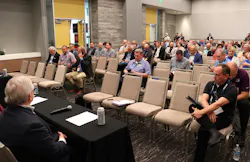
Craigen encouraged fleets to invite suppliers to safety meetings or shop shifts for hands-on instruction. “There’s nothing better than getting somebody from the outside with a fresh face to be a part of those presentations or out in your shops training technicians,” he concluded.
“Your suppliers are happy to do it—and your team usually gets fed.”
About the Author
 Jason McDaniel
Jason McDaniel, based in the Houston TX area, has more than 20 years of experience as an award-winning journalist. He spent 15 writing and editing for daily newspapers, including the Houston Chronicle, and began covering the commercial vehicle industry in 2018. He was named editor of Bulk Transporter and Refrigerated Transporter magazines in July 2020.