Ultimate vindication: Intensive audit hones Usher’s winning Heil bid
Key Highlights
- Usher Transport is one of only two companies in 34 years to earn the accelerated Responsible Care Partner certification on their second attempt.
- Certification led to improved safety performance, industry access, and North American safety awards, including the Heil trophy.
- The company employs advanced safety technologies like Motive cameras and AI data to foster a non-punitive, performance-driven culture.
- Usher’s safety initiatives include driver bonuses, chaplain services, and a thorough interview process to ensure top talent.
- Strong relationships with clients like Chevron demonstrate trust and shared commitment to safety and accountability.
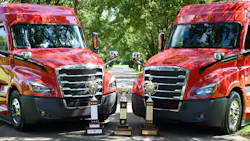
Usher Transport is unique. So is the road it traveled to Responsible Care Partner certification. The Kentucky-based tank truck carrier is one of only two companies in the program’s 34-year history to complete the rigorous process in the accelerated one-year window the American Chemistry Council allows candidates in their second attempt at accreditation.
“It was professionally gratifying to see them return,” said Greg Rhoads, a senior ACC advisor who manages the Partner program. “Usher already had a strong safety program. That’s true. But they learned some things about themselves by going through the process. They saw gaps they hadn’t seen before, made changes, and they improved—and that’s the value of the program.”
The rewards extend far beyond a plaque on the wall. For Usher, certification enhanced safety performance and increased access to leading petrochemical manufacturers, many of whom require RCP participation to haul their loads. And, in Usher’s compelling case, the process propelled the fleet to another National Tank Truck Carriers North American safety championship, the carrier’s first as one of 43 RCP-certified companies in the program’s bulk-sector category—more than a third of which have claimed NTTC’s top safety honor at some point.
“That isn’t by happenstance,” Rhoads said. “It’s by design. These are all excellent companies, so it makes me smile to see them recognized.”
Usher’s leaders say cementing Partner status in the same year they claimed their third Heil trophy was a key factor in the company’s award-winning success. But it certainly wasn’t the only one. The carrier also applies a thorough, standard-setting interview process to ensure only the most qualified prospects join their team; offers safety bonuses and chaplain services as part of their pledge to care for drivers’ well-being; and leverages Motive cameras and artificial intelligence-generated data in an “intimate,” non-punitive approach to performance improvement that includes ongoing training—and produces some of the best drivers in the industry.
“They have consistent drivers who they treat very well, and you can tell immediately the difference between an Usher driver and the other carriers’ drivers,” said Deidra Collins, operations manager at Chevron’s Louisville lubricants plant. “They always pay attention to the details, they’re accountable, and many of them are like family because they’ve been coming here for years.”
The winning blueprint
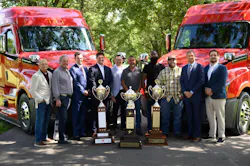
Usher emerged as champion of the Sutherland division, which includes carriers who traveled fewer than 15 million miles, despite carrying the most exposure in the group as the division’s highest-mileage Grand award winner. Usher delivered nearly 90,000 loads and covered almost 14 million miles with only two DOT-recordable incidents—one of which was ruled internally as non-preventable—for an accident frequency of 0.152 per million miles.
Neither incident occurred in Kentucky—where Usher maintains three terminals and annually records the most miles.
“Our goal is to win the Heil trophy every year, and not just so we can show off the hardware,” Usher COO Eric Mink said. “That’s great, too, but if every year we’re striving to be the safest tank truck carrier in North America, we’re going to be in the top 2-3%, whether we win that award or not.”
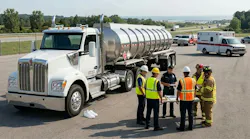
RCP certification improved Usher’s chances this year, Mink added, forcing them to recalibrate how new products are evaluated. “Previously, we reviewed the Safety Data Sheet to ensure we had the right equipment,” he shared. “But we didn’t consider the safety of the driver, as far as respiratory dangers or other issues involved with handling the product.
“Documenting that process gave us a whole new peace of mind.”

 tank_truck_safety_editorial
From there, the main concern for Beau Mosley, Usher’s chief risk officer, was making sure the team’s hard work was captured in their Heil submission—a tall task to be sure, but one that pales in comparison to the humbling, year-long “gut check” required for Partner certification. “I put 40-plus hours into filling out that application, because our people, and especially our drivers, did the work to earn this award from a numbers perspective,” Mosley said. “So I wanted to make sure I did my part to secure the recognition they deserve by putting in the time and effort to optimize our submission.”
That dedication is intentional, too. It’s the foundation of Usher’s broader corporate philosophy—which dictates an uncompromising approach to building championship-caliber operations. “Being people-focused is not about being tolerant,” cautioned Ryan Usher, Usher president and CEO, who’s also a certified Air Force instructor. “It’s about being relentless. You must ensure the right people are in the organization, and that necessitates tough choices.
“Then you take care of your people—and they will take care of the mission.”

A shipper’s-eye view
Chevron’s bulk lubricants operation on the Ohio River in Louisville’s Rubbertown area includes 100 storage tanks and 30 employees. As the facility’s primary transporter, Usher annually hauls out 2,500 tank trailers filled with Chevron products—all of which are loaded by Usher’s dedicated drivers, who even help train competitors on plant procedures. The drivers are so ingrained in the operation that Chevron treats them like family—inviting them to company events and gifting them the same T-shirts employees receive. Collins specifically noted veteran drivers and long-time managers feel like direct extensions of her own team.
“We’ve talked about moving to a model where our employees load the trucks,” Collins revealed. “But that would add costs, with increased head count and oversight, so we truly appreciate the relationship with Usher.
“We don’t have to worry about it because the trust factor is there.”
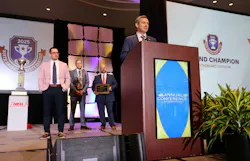
 Ronnie McCoy, SWTO manager of fleet safety, training, and compliance, raises his plaque in celebration upon hearing his company revealed as the private-fleet Grand Champion in National Tank Truck Carriers’ 2025 North American safety contest during the 2026 NTTC Annual Conference in Baltimore.
That deep-rooted reliability extends well beyond the loading rack. If a mechanical or quality issue arises, neither party points fingers, Collins said. Instead, they work together to troubleshoot the problem. “If there’s a mistake, they don’t run from it,” Collins said. “We can own it—and they can, too.” Sustained accountability recently helped Usher claim Chevron’s Bulk Lubricants Carrier of the Year award for the third time in four years—an honor that factors in safety, cost competitiveness, and feedback from local plants. And, while Collins admits she initially was unaware of Usher’s latest NTTC safety accolade, she insists logistics teams “absolutely” pay attention to high-level industry honors when negotiating contracts.
“I’ve told them they should toot their own horn more, because I’m so proud of them—and we want to celebrate their achievements, too,” Collins said.
And shippers who view carriers as partners worth celebrating—rather than line-item expenses—are exactly the customers Usher’s leadership team wants to attract in a volatile freight market.
“We want to be quality-focused—and not all about price in terms of customer relationships,” Ryan explained.
Generational validation
The U.S. Supreme Court ruled in Montgomery v. Caribe Transport II in May that freight brokers can be sued under state negligence laws for hiring unsafe motor carriers, placing a renewed spotlight on broker and shipper responsibilities in carrier vetting—and what qualifies as a “passing grade” with price-focused shippers. “We’ve always had marks on safety, so I’ve asked shippers, do you pay attention to safety performance? Are you looking for an ‘A’ student—or one with a passing grade?” Mink relayed. “Unfortunately, all too often, I hear, ‘We just need a ‘C’ student.’
“Now, when you tell them you’re a Responsible Care member, that really gets their attention.”
The Montgomery ruling, combined with the increasing threat of “thermonuclear” jury verdicts, has “flipped the script,” he argued, turning elite credentials like RCP certification and Heil trophy wins into a critical “arrow in the quiver” for carriers like Usher who are operating responsibly.
The timing only intensifies Ryan’s appreciation.
Usher’s leader was still a kid when his father and uncle shared stories about their inspirational 2001 safety championship, and he was a dispatcher at Usher’s Atlanta terminal when they repeated in 2013, but those memories are still fresh. And winning again in 2025 proves the family business—which this year celebrated its 80th anniversary—is heading in the right direction. “I feel as proud today as I did when I was a kid,” Ryan said. “This is validation that we’re resetting the company after a generational transition exactly how we intended.
“We’re doing what we promised we’d do.”
Usher’s unwavering commitment to excellence in all endeavors makes it a destination employer for people like CFO Wilson Tucker, who joined the company in 2022. And with the legal landscape actively shifting to penalize safety negligence, Tucker believes Usher’s uncompromising standards are poised to pay serious dividends. “Shippers are looking for people that are more legitimate, and we’re the gold standard of legitimacy,” Tucker concluded. “So, I think it’s going to push some carriers out—and it definitely puts us in the driver’s seat.
“Really, it’s vindication for our approach.”

About the Author
 Jason McDaniel
Jason McDaniel
Jason McDaniel, based in the Houston TX area, has more than 20 years of experience as an award-winning journalist. He spent 15 writing and editing for daily newspapers, including the Houston Chronicle, and began covering the commercial vehicle industry in 2018. He was named editor of Bulk Transporter and Refrigerated Transporter magazines in July 2020.