Resilience in bulk: Tank truckers band together in Baltimore
Key Highlights
- The industry experienced a surge in equipment orders and signs of entering a recovery phase driven by demand in core sectors like energy and chemicals.
- Leadership changes include Jeremy Mairs becoming the new NTTC chairman, emphasizing membership growth, advocacy, and workforce development initiatives.
- The launch of the Tank Truck Institute aims to enhance education, training, and workforce pipelines to ensure industry sustainability and attract new talent.
- NTTC's partnership with Wreaths Across America reflects a commitment to honoring veterans and supporting community engagement.
- Market data indicates slight increases in freight tonnage, revenue, and tractor counts, signaling cautious optimism for industry recovery.

The tank truck industry navigated one of the most complex operating environments in recent history in 2025—a year shaped by economic pressures, policy shifts, and planning uncertainty. And succeeding in this environment isn’t growing any easier this year, with mounting tariff repercussions and surging fuel prices further complicating capital investment decisions.
But there are some encouraging signs.
“Fundamentals have begun to improve, capacity is tightening, and we’re seeing a bit of a surge in truck orders as of late. They’re up dramatically year-over-year,” National Tank Truck Carriers President and CEO Ryan Streblow said during his president’s report at the 2026 NTTC Annual Conference in Baltimore, Maryland. “And there are some signals of us entering a recovery period. In the chemical and energy sectors, which are core to tank truck operations, we are seeing steady—if, at times, uneven—demand. Energy investments, infrastructure activity, and data-driven industrial growth are providing a stronger foundation than we experienced in 2025.”
Editor’s Note: For an inside look at the 2026 NTTC Annual Conference in Baltimore, view our expanded media gallery. This collection features new NTTC Chairman Jeremy Mairs, the launch of the Tank Truck Institute led by Luma's Gina Anderson, and Distinguished Service Award recipient Steve Rush.
Streblow also highlighted NTTC’s regulatory and legislative priorities, ongoing work on Capitol Hill, and the importance of the upcoming midterm elections. And he insisted the association is well-positioned strategically and financially to expand its impact and deliver greater value for members, pointing to growing engagement and strong attendance as evidence. Tank Truck Week posted its second-highest attendance number last October in Kansas City, Missouri, and the 2026 Annual Conference drew over 500 attendees to Baltimore for three days of committee meetings, expert presentations, and solutions-filled exhibit hall booths.
“We face real challenges: elevated costs, regulatory uncertainty, geopolitical risks, and political complexity,” Streblow said. “But we also see real opportunity. Freight markets are stabilizing, demand in key sectors is strengthening, investment is beginning to return, and our industry—disciplined, safety-focused, and essential—is well positioned. The tank truck sector has always been resolved. We do not simply endure change, we adapt, we innovate, and we lead.
“And as we look into 2026, I am confident—not cautiously, but firmly—that the best days of our industry are still ahead.”
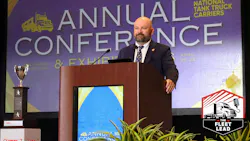
Mairs is NTTC’s 79th chair
Association leaders elected Jeremy Mairs, Cox Petroleum president and CEO, as the 79th NTTC chairman during the board of directors meeting and introduced him to members after the safety awards luncheon. He succeeds David Price, United Petroleum Transports executive vice chairman, who received his crystal tank truck and chairman’s portrait during the board meeting.
Mairs grew up in the industry, officially joining Bakersfield, California-based Cox Petroleum—which his parents acquired in 1990—at 14 years old. He spent eight years in the shop and five years on the road, hauling lube oils and fuel across the Western U.S., before moving into the office. He bought the business from his parents in 2019. “This isn’t just what I do,” Mairs said in an introductory video. “It’s what I know, what I care about, and what I believe in.”
Mairs laid out his agenda in the video: grow and strengthen membership, increase involvement in NTTC’s Political Action Committee, and build a stronger advocacy presence in Washington. Then he took the stage to thank NTTC members for their support before closing out the conference.
“As we look ahead, my focus is straight forward,” Mairs said. “I want to continue building on the momentum we created, I want to stay engaged on advocacy, invest in our people through education and development, and ensure that NTTC continues to deliver real value for our members. I’d also encourage each of you to think about others in your organization who would benefit from being more involved. That’s how we continue to grow and strengthen this association.”

Tank Truck Institute launch
NTTC officially launched the Tank Truck Institute, a nonprofit foundation dedicated to advancing education, training, and workforce development, and fostering a positive image for the tank truck industry.
“We created this foundation for one simple but powerful reason: We want to ensure that the next generation is ready and proud to carry this industry forward,” said Dr. Gina Anderson, CEO of Luma Brighter Learning and first Tank Truck Institute chair. “We all know we need more highly skilled drivers. We need more highly trained technicians. We need stronger pipelines of talent, and we need to tell our story better, to show the world who we are and why the tank truck industry matters.
“TTI will help us meet those challenges head on.”
The foundation will support education by developing tank truck-specific curriculum; provide scholarships and learning opportunities; invest in training programs that elevate safety, professionalism, and technical expertise; and build new pathways that drive workforce development, Anderson said.
Industry stakeholders are encouraged to make a tax-deductible contribution at tanktruckinstitute.org.
“This is our moment to invest in the future of the tank truck industry, not just equipment, not just our infrastructure, but in its knowledge and learning and skills, and our biggest asset—our people,” Anderson concluded.

WAA partnership
NTTC this year is partnering with Wreaths Across America to help place wreaths on veterans’ graves at Arlington National Cemetery on Dec. 19 on National Wreaths Across America Day. “Our goal is to fund at least one full trailer load of wreaths [which is approximately 4,500 wreaths], giving our members a meaningful way to honor those who have served while supporting NTTC’s advocacy efforts,” said outgoing NTTC Chairman David Price.
Wreaths cost $17 and NTTC will receive $5 back for each wreath sponsored through the program.
“To date, Wreaths Across America has given back $25 million to nonprofit organizations since they began the $5 payback program, so that they can use those funds to support their own veteran workforce or for their own programs,” said Elisabeth Barna, founder of EAB Strategies and long-time WAA advocate. “So, NTTC will use those funds to support and honor veterans in the association, including professional drivers, technicians, dispatchers, safety personnel, tank watch technicians, office personnel, welders, and more.”
To sponsor a wreath, visit NTTC’s page at wreathsacrossamerica.org/nttc.
The wreaths are targeted for Arlington National Cemetery, but sponsors can designate other cemeteries, Barna said. They also will have the opportunity to nominate team members to be recognized in Washington during National Wreaths Across America Day events.

Distinguished Service Awards
Past NTTC chairman Herb Evans, vice chairman at Eagle Transport, presented Distinguished Service Awards to John Conley, a past NTTC president and Bulk Transporter editor, and Steve Rush, a past NTTC chairman and the founder of New Jersey-based Carbon Express.
“The Distinguished Service Award is one of NTTC’s highest honors,” Evans said. “It recognizes individuals who have given their time, leadership, and expertise to help move this industry forward.”
Following a 10-year stint as Bulk Transporter editor, Conley joined NTTC in 1989 and served as president from 2006 to 2013. “John’s been a key voice in the tank truck industry for decades,” Evans said. “From the time he led NTTC as president … to his work on communications, safety, and regulatory issues, John has helped shape the way this industry operates and how it’s represented. His knowledge, leadership, and dedication have had a lasting impact that continues to be felt to this day.”
Rush grew up driving farm trucks. After serving in the Air Force, he entered the trucking business, hauling everything before eventually making his way into the tanker sector, where he made his mark, Evans said. Rush became an owner-operator in 1969, founded Carbon Express in 1983, and rose to NTTC Chairman in 2010. He retired after selling Carbon Express to Kenan Advantage Group in 2022. “Over the years, he’s been a leader in this industry, remaining engaged with NTTC and actively involved at the national level throughout his career,” Evans said. “Even in retirement, his impact and legacy continued to be felt across the nation.”
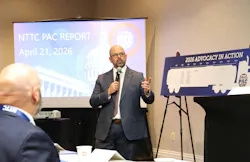
PAC update
NTTC’s Political Action Committee surpassed $100,000 in donations for the sixth consecutive year during this year’s Annual Conference, hitting $112,000. NTTC members donated a record $140,675 in 2025.
Association leaders also modified NTTC’s list of legislative and regulatory strategic priorities for 2026 during the Executive Forum in February, moving emissions from Tier I to Tier II and the dry bulk axle variance from Tier II to Tier I, which includes tank truck-specific issues for which NTTC aims to lead the charge. “This is a top legislative priority, and we continue to push hard to have the language included in the [current surface transportation reauthorization bill, which expires in September],” said NTTC lobbyist Britton Clarke Mullen.
The other Tier 1 priorities are electronic shipping papers, Federal Excise Tax repeal, and workforce issues. And Delilah’s Law is one of the key legislative actions that will impact the tank truck workforce. The bill, introduced by Rep. David Rouzer, a Republican from North Carolina, would prohibit states from issuing CDLs to undocumented immigrants, ensure CDL holders demonstrate English proficiency, and place drivers who don’t meet the criteria out of service.
“I want to highlight an important NTTC victory here,” Mullen said. “Earlier versions of this bill included a mandate requiring that every current CDL holder undergo a nationwide recertification within 100 days of the bills’ enactment. Obviously, this would have been a huge operational burden on all of your businesses, so this was your advocacy at work. We were able to get that language stripped out of the bill and then continue to move the bill forward.”

Tank truck market outlook
Carriers are navigating a complex economic landscape defined by significant cost headwinds and shifting demand drivers, Emily Clayton, American Trucking Associations senior economic analyst, indicated in her tank truck market update. Fiscal policy and tax refunds provided some stimulus, but the Iran war severely impacted the industry by driving up diesel prices; and, while inflation has cooled from its 2022 highs, it remains elevated, and the “price level” of goods has surged nearly 30% since 2020, impacting consumer behavior and freight movement.
“Going into this year, we were anticipating two cuts to the federal funds interest rate,” Clayton said.
“Now [because of the Iran war] we are definitely not expecting that.”
More positively, the 42,000 motor carrier exits since late 2022 and a decrease in tractor counts is allowing freight rates to begin a modest recovery from the bottom, Clayton said. That’s welcome news for freight-recession survivors because operational costs grew 26% faster than freight rates over the last few years, creating an unsustainable environment for many operators. The latest report also highlights slight gains in tank truck tonnage, revenue, and tractor counts from 2024 to 2025. Tonnage increased from 2.08 to 2.09 billion tons, tractors went from 166,492 to 167,439 units, and revenue rose from $39.4 to $39.5 billion.
The full 2026 Tank Truck Industry Market Analysis is available now at tanktruck.org. It features over 50 pages of data and graphs highlighting the size and scope of the tank truck segment, including tonnage, revenue, and tractors for the total industry, for-hire, and private fleets across 12 commodity groups, with 2024 and 2025 data, and forecasts for 2030 and 2035.

Driver compensation report
Bulk haulers continue to enjoy a competitive advantage in driver pay and lifestyle compared to the broader trucking industry, according to Cottingham & Butler’s latest Tank/Bulk benchmark report, which includes data from more than 70 fleets. A major finding is the disparity in home time. While only 9% of dry van and refrigerated drivers are home every night, 33% of tank truck drivers make it home nightly—with another 33% home three or four nights a week. This is largely due to the prevalence of shorter hauls, with 83% of tank and bulk operations involving runs of less than 500 miles, compared to only 44% in all of trucking.
Regarding compensation, the bulk sector has historically paid better, and the gap is widening, the report suggests. Tank truck drivers now earn 11.3% more than their peers in other sectors. Median annual pay for drivers paid by the mile reached $83,500 in 2026, while those paid by the hour—often local or short-haul drivers—saw an increase to $84,000 per year.
“If you're out there competing for drivers against the other segments of the industry, you have a great story,” said Kim Beck, Cottingham & Butler vice president of benefits consulting.
Superior pay and quality-of-life metrics result in the lowest turnover rate in the trucking industry. The voluntary turnover rate in the tank/bulk segment sits at 36%, which is much lower than the 52% average reported across all segments. “You guys get your drivers home more often, they drive fewer miles, and they make more money, so they’re job hopping less,” Beck concluded.
The full report is available to NTTC members and participating fleets. Contact Beck at [email protected] or visit truckingsurvey.com for more information or to learn how to participate.
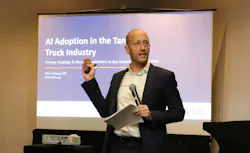
AI adoption survey
A new survey from BeyondTrucks involving 50 responses from tank truck companies reveals that while industry leaders recognize the potential for AI to improve safety and load planning, a strategic vacuum still exists, as 74% of companies surveyed lack a formal implementation plan. The analysis identifies data integration and a lack of internal expertise as the primary obstacles preventing carriers from moving past the exploratory phase.
“There’s a strong blind spot in the industry, and it’s the fact that leadership tends to pass on AI decisions to IT,” BeyondTrucks CEO Hans Galland said during the Workforce Committee meeting. “In many organizations, no one is comfortable with AI implementation and very few have thought through the impacts of how they change what tasks a dispatcher does, or a back-office employee, or even a driver. The biggest challenge that comes with that delegation to IT is that AI is a general-purpose technology, and it will change the way we complete work.
“So, inherently, with that comes a problem where IT is about technology, but this is more about how we work, how we organize ourselves, what work you complete as a fleet, what work your customers complete, and what work your vendors complete. And rethinking that is a business exercise.”
To bridge the gap, Galland proposed a comprehensive roadmap focused on workforce reskilling, strategic vendor partnerships, and federal advocacy to secure tax incentives and regulatory modernization.

About the Author
 Jason McDaniel
Jason McDaniel
Jason McDaniel, based in the Houston TX area, has more than 20 years of experience as an award-winning journalist. He spent 15 writing and editing for daily newspapers, including the Houston Chronicle, and began covering the commercial vehicle industry in 2018. He was named editor of Bulk Transporter and Refrigerated Transporter magazines in July 2020.