Challenge accepted: Betts keeps tank truck carriers moving during pandemic
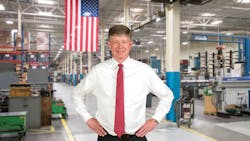
Betts Industries, founded in 1901, has been around long enough to have experienced multiple recessions, the Great Depression, two world wars—and now two global pandemics, including the 1918 influenza, or Spanish Flu.
“Unfortunately, they didn’t leave us any CliffsNotes on how to get through it,” Betts president and CEO Charles (Chad) Betts lamented.
Still, with Chad Betts, the fifth generation of family leadership, charting the course, the Warren, Pennsylvania-based equipment manufacturer found a way to keep its doors open, its workforce safe, and tank truck carriers supplied with the components they needed to keep America moving during the COVID-19 pandemic.
And with exponential advances in technology and data collection since 1918, Chad vows future generations of Betts Industries leaders will have a wealth of information to sort through before the next worldwide health scare.
“Chad’s claim to fame historically will be that he’s the president that carried us through COVID,” said Michelle Betts, vice president of marketing and business development. “But really, when you look at the history of this company, we’ve weathered many storms, and we’ve been able to come out on the other side.”
Essential service
Betts Industries has supplied essential equipment for more than a century.
The company’s headquarters are located only 40 miles from the Drake Well, which is the first commercial oil well drilled in the United States, back in 1859. The well’s success sparked the country’s first great wave of investment in oil drilling, refining and marketing, and helped make Betts—founded as an iron foundry and machine shop that supported the area’s oil industry—a key player in the initial oil boom.
In the 1940s, after World War II, Betts entered the liquid tank industry, which now is the primary industry the company serves, and the “bread and butter” of its business. Betts remains a “significant player” in the petroleum industry, with valves, vents, manholes and lighting systems for tanks; maintains a key presence in the chemical tanker market with its stainless-steel products; and also holds a smaller position in pneumatic dry bulkers.
“If you’re looking at a DOT 406, 407 or 412 type of tank, there’s a very high probability you’re going to see Betts equipment on there,” Chad said.
Considering the importance of the trucking industry, and particularly tank trucks—which haul many critical products—in keeping the country supplied, Chad never considered he might have to close his company’s doors, even after the coronavirus reached the United States last March, and shutdown rumors began to circulate.
Then his wife informed him otherwise.
Chad says he was relaxing at home at 5 p.m. on March 19, 2020, when Tawni told him Pennsylvania Gov. Tom Wolf had just ordered all non-life-sustaining businesses to close their physical locations—by 8 that evening.
“I certainly didn’t see anything like that coming,” the Betts president admits. “If you would have asked me about closing in March of last year, I would have said, ‘They’re not going to shut us down. There’s no way they shut us down.’ And I would have said that right up until my wife told me they had just shut us down.”
He quickly sprang into action, organizing a management meeting that night, but looking at the information available, they weren’t prepared to go against the mandate, and risk potential citations, fines, or worse. “We could not make the case, based on the information in front of us, that we were exempt from shutting down,” Chad recalled. “We felt we should be exempt, but we went ahead and shut down.”
Then they learned they could make their case to state authorities, and if deemed essential could re-open, so Chad prepared Betts’ plea the next day, making sure to point out their products are utilized in the transport of cleaners and hand sanitizers needed to fight COVID-19, and key components that go into foods.
“Transportation is a key industry for keeping the country moving, and getting supplies where they need to go, so that was an obvious part of our case,” Chad said. “In addition, a lot of our valves on the stainless side are used in chemical processing, and for moving chemicals, which connects to the pharmaceutical industry.”
A few days after the proper paperwork was filed, Betts officially was deemed essential, so employees returned to work March 25. In addition to Chad’s efforts, Michelle said many of Betts’ customers played a key role in helping them make their case, and Betts paid its forward by sharing their successful approach with other area businesses in the same predicament. “This was an all-hands-on-deck initiative,” she said.
“The industry really pulled together. It was remarkable to see.”
Staying safe
Betts leaders used those five forced days off to create a comprehensive plan, based on recommendations from the Centers for Disease Control, for keeping employees safe and productive. Betts installed hand sanitizer stations, instituted cleaning regiments and enforced social distancing. Then, on April 15, in accordance with changing CDC business and safety mandates, masks became a requirement.
The company also locked down its facility in an effort to minimize exposure to the outside world, including adding portable toilets outside to provide facilities for visiting truck drivers, and sent some of its employees home to work remotely, although the majority of its manufacturing workforce must be on location.
To compensate, Betts introduced an additional two weeks of paid sick leave for anyone who was displaying any kind of COVID-related symptoms, even before the Families First Coronavirus Response Act (FFCRA) was passed. “The idea was to incentivize anybody in our workforce who felt they had COVID-like symptoms to stay home,” Chad explained.
After FFRCA, Betts left its new policy in place through 2020, and recently extended it through June 30, 2021. “In essence, our workforce had four weeks of paid sick leave, with two weeks’ worth through the FFCRA, in addition to the two weeks of paid sick leave from the company,” Chad said. “Looking back, that was one of the major things we did to try to get ahead of the pandemic, and keep our workforce as healthy as possible.”
Chad said they had “quite a few” employees take advantage of the extra sick leave early on, when anyone who had the sniffles feared they might have COVID-19, but its usage tapered off quickly in April, when reality began to set in that the pandemic—and our dreaded “new normal”—wasn’t going to end anytime soon.
Michelle said full transparency with employees about key decisions throughout the pandemic was critical in keeping them informed, engaged and on board, so that Betts could continue to safely produce and ship equipment. Communications included daily updates on new policies and government announcements via website postings, emails and small, department-level “pop-up” meetings with personnel.
“That helped to ease tensions and concerns during a very difficult time,” Michelle confided.
Business impact
The most difficult decisions involved keeping their workforce intact.
“We went from being very busy in early 2020, to dropping off dramatically within weeks,” Chad said. The resulting inactivity left little for employees to do, and a dwindling revenue stream from which to pay them. So Betts applied for and received a Payroll Protection Program loan, which was part of the Coronavirus Aid, Relief, and Economic Security (CARES) Act, through the U.S. Small Business Administration.
“We used those eight weeks of PPP to keep people here and engaged,” Chad recalled. “But at the end of that term, the business still hadn’t rebounded anywhere close to where it had been, so we ended up having to lay off 52 people, out of around 275 total people at that point. So it was a pretty severe cutback.”
The good news is they’ve now recalled most eligible employees, boosting their workforce back to approximately 265 people. And, Chad said, demand for their products steadily has increased this year, and now is close to “pre-COVID” levels.
“The aftermarket remained strong through this whole ordeal, while our OEMs took a more cautious position,” Michelle said. “Some managed their labor by shutting down, so in turn our numbers dropped. And I think our OEMs now are optimistic about the future, but they’re going to remain cautious over the next three to six months. They’re also looking more toward non-traditional opportunities, whereas in the past they were more petroleum focused. And the one thing that has remained strong is our international presence.”
Minimal reliance on the international sourcing of raw materials helped Betts maintain its 2017 commitment to reduced lead times during the pandemic, Chad said, but as the economy ramps up, he’s seeing more supply chain strains.
“We feel like we’re pretty much back to where we were, and we’re going to continue moving forward with the initiatives we’ve had in place,” he said.
“We had just revamped our entire ERP (enterprise resource planning) system, which we’d lived with for the better part of 40 years—and we spent a year and a half working on it—right before COVID, and went live with that in December (2019). So we were right in the thick of all that when the virus hit. But we managed all that, and there were some hiccups there, too, but for the scope of that change, it went pretty well.”
Company leaders now insist Betts Industries will continue to reevaluate its policies, positions and procedures; build on valuable lessons learned; and adapt to whatever the world throws at their 120-year-old business.
They just hope it’s not a global pandemic—for at least another century.
“I really don’t want to do it again,” Chad said.
About the Author
 Jason McDaniel
Jason McDaniel
Jason McDaniel, based in the Houston TX area, has more than 20 years of experience as an award-winning journalist. He spent 15 writing and editing for daily newspapers, including the Houston Chronicle, and began covering the commercial vehicle industry in 2018. He was named editor of Bulk Transporter and Refrigerated Transporter magazines in July 2020.