How drones bolster bulk terminal security and incident response
Key Highlights
- CargoNet recorded more than 3,500 supply chain theft and crime events across the U.S. and Canada in 2025.
- Automated drone-in-a-box systems can provide rapid aerial views of perimeter alarms and help document incidents.
- Vehicle-mounted drones for in-transit freight remain largely conceptual because of FAA restrictions and hazardous-atmosphere safety requirements.
- Under the SAFER SKIES Act, private operators can detect and track unauthorized drones but generally cannot mitigate them.
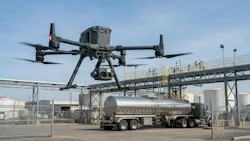
Bulk terminal operators and industrial logistics facilities are increasingly looking beyond traditional fencing and fixed cameras to unmanned aerial systems for faster perimeter monitoring and incident response.
Rising freight crime across North America is driving that interest, with supply chain security firm CargoNet recording more than 3,500 supply chain theft and crime events across the U.S. and Canada in 2025, and quarterly theft losses jumping from $135.7 million in Q2 2025 to $304.6 million in Q2 2026. Globally, BSI Consulting and insurer TT Club have warned of escalating organized freight theft, while Munich Re data indicates that 41% of cargo thefts occur in transit compared with 21% at terminals and warehouses.
Extending visibility from yard to cab
While unmanned aerial vehicles (UAVs) have been used by military and public safety agencies for decades, lower hardware costs and improved automation have expanded commercial adoption across industrial facilities. Most logistics headlines focus on last-mile parcel delivery or fulfillment centers, yet site security and situational awareness represent a more practical fit for bulk operations.
Bulk terminals and tank fleets share a core vulnerability: both hold high-value liquid or dry-bulk commodities, but one is stationary and the other is constantly on the move. Fixed facilities can rely on perimeter fencing, access gates, lighting, cameras and security patrols, whereas over-the-road tractors and trailers lack that physical envelope once they leave the gate.
Automated yard-deployed drones are already helping bridge that gap at large facilities, while security technologists are exploring whether vehicle-docked systems could eventually give drivers and dispatchers aerial eyes on suspicious activity or route hazards without drivers leaving their cabs. Broadly, commercial security programs evaluate two categories of drone tools:
- Proactive drone deployment: Automated “drone-in-a-box” systems or operator-launched aircraft provide live aerial video of perimeter alarms or incidents, capture evidentiary footage, deter trespassers and help coordinate emergency responders.
- Counter-drone detection systems: Multi-sensor platforms detect, track and identify unauthorized UAVs approaching sensitive terminals, ports, transload yards or high-risk industrial assets.
Connected to site security or operations centers, these feeds allow personnel to verify alerts in real time rather than waiting for ground patrols to reach a remote fence line.
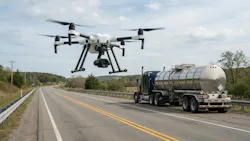
Exploring concepts for in-transit vehicles
Because in-transit incidents account for the largest share of cargo losses tracked by Munich Re, security providers have begun exploring how compact, vehicle-docked drones might one day support high-risk freight during unscheduled stops, staging or route disruptions. In concept, a short-range drone launched from a vehicle-mounted charging station could stream live overhead video to help drivers and dispatchers assess blocked roadways or security threats ahead.
For commercial tank fleets, however, mobile deployment remains largely theoretical. Routine roadside or in-transit use faces significant regulatory and safety hurdles, including FAA Part 107 remote-pilot certification, visual-line-of-sight and moving-vehicle restrictions, and strict hazardous-atmosphere rules prohibiting non-rated electronics near flammable or volatile cargoes.
Covering terminals under federal rules
Near-term adoption is far more practical at bulk terminals, rail-to-truck transload facilities and tank staging yards, which often span dozens or hundreds of acres with dense clusters of storage tanks, pipe racks and parked trailers. Ground patrols can take critical minutes to reach a perimeter breach, whereas an automated drone can launch on a sensor alert and put eyes on an incident within seconds—using pre-programmed geofences to stay clear of active loading racks and classified hazardous locations.
Continuous airspace monitoring software can also alert terminal managers when unauthorized drones enter private airspace—a growing concern around critical energy, chemical and industrial infrastructure. Under the federal SAFER SKIES Act, however, actively mitigating a hostile drone by disabling or seizing control of it is restricted to accredited state, local, tribal or territorial (SLTT) law enforcement and correctional agencies that have completed federal training and certification.
Private bulk carriers and terminal operators can legally detect and track unauthorized drones, but they cannot take direct counter-UAS mitigation action themselves. As a result, critical infrastructure operators typically use a public-private approach—deploying detection platforms compatible with local law enforcement systems and establishing response protocols with accredited agencies. State port authorities are a notable exception, as many maintain sworn police departments eligible for SAFER SKIES training and mitigation authority.
At the same time, those restrictions apply only to disabling rogue aircraft; private terminal operators can still deploy their own security drones in response to perimeter sensors or camera alerts to investigate traditional threats such as trespassing, vandalism and theft.
Building layered security
Drones are not a replacement for foundational tank fleet security—such as vetted drivers, secure parking, tamper-evident seals and strict terminal access controls—but paired with clear law enforcement partnerships, aerial detection and response tools offer bulk terminal operators faster visibility when incidents unfold.
About the Author
 Drew Weston
Drew Weston, CPP, is an enterprise access control specialist for federal markets at Motorola Solutions and previously served as director of national accounts for Mobile Communications America. He also serves as volunteer chair of the UAS/C-UAS Cross-Sector Council for the InfraGard National Members Alliance.
Related
 adobestock_87937345
 adobestock_30106013