FTR: Trucking conditions improve in February

FTR’s Trucking Conditions Index for February rose nearly a full point month over month to a 10.2 reading—the highest level in four years—due to a further strengthening in freight rates.
The record surge in diesel prices in March was a huge short-term hit for carriers, and could result in a negative TCI reading, FTR cautioned; but the preliminary assessment still shows a marginally positive reading due to strong freight rates and capacity utilization.
Either way, the March TCI will be an outlier, the firm reported.
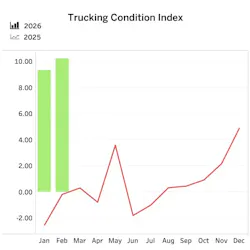
“Extreme volatility in fuel prices—especially with the just-announced ceasefire in the Middle East—and uncertainty over how the spot market will respond to falling diesel prices make the near-term truck freight market far more difficult to forecast than the longer-term outlook, which remains solidly favorable for carriers,” Avery Vise, FTR vice president of trucking, said in a news release. “The freight market’s response this year to weather and diesel prices confirms how much capacity has tightened.
“As we explored in our latest update for clients, the real question is whether freight volume will support an acceleration of freight rates or whether carriers will merely hold recent gains.”
Details of the February TCI are found in the April issue of FTR’s Trucking Update. The April issue includes commentary revisiting the outlook for freight volume. Trucking Update includes data and analysis on load volumes, the capacity environment, rates, and the economy.
The TCI tracks the changes representing five major conditions in the U.S. truck market: freight volumes, freight rates, fleet capacity, fuel prices, and financing costs. The individual metrics are combined into a single index indicating the industry’s overall health. A positive score represents good, optimistic conditions. Conversely, a negative score represents bad, pessimistic conditions. Readings near zero are consistent with a neutral operating environment, and double-digit readings in either direction suggest significant operating changes are likely.