Chicago interchange tops ATRI’s 2026 Bottlenecks list
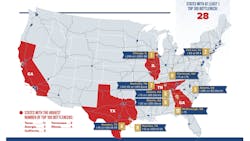
The interchange of Interstates 294, 290, and 88 in Chicago ranks as the most congested freight bottleneck in the country in the American Transportation Research Institute’s newly released list of the top truck bottlenecks in the United States.
As Congress prepares to reauthorize the country’s surface transportation programs before current funding expires in September, the 15th annual Top 100 Truck Bottlenecks list delivers timely analysis that can help local, state, and federal officials target funding where it’s most needed, ATRI asserted.
“Congestion delays inflicted on truckers are the equivalent of 436,000 drivers sitting idle for an entire year,” Rebecca Brewster, ATRI president and COO, said in a news release. “While these congestion metrics are getting worse, the good news is that states do not need to accept the status quo. Illinois has been home to the country’s top bottleneck before, but following a sustained effort to expand capacity, its previous No. 1 bottleneck at the Jane Byrne Interchange no longer ranks in the top 25.
“This data gives policymakers a road map to reduce chokepoints, lower emissions, and drive economic growth.”
The new Top Truck Bottleneck List measures the level of truck-involved congestion at more than 325 locations on the national highway system. The analysis, based on an extensive database of freight truck GPS data, uses several customized software applications and analysis methods, along with terabytes of data from trucking operations to produce a congestion impact ranking for each location, the organization reported. ATRI’s truck GPS data is also used to support the U.S. Department of Transportation’s Freight Mobility Initiative. The bottleneck locations detailed in this latest ATRI list represent the top 100 congested locations, although ATRI continuously monitors more than 325 freight-critical locations.
For the first time ever, the intersection of I-294 and I-290/I-88 in Chicago is the top freight bottleneck in the country, surpassing the long-standing No. 1 bottleneck in Fort Lee, New Jersey. The remaining Top 10 bottlenecks include:
- Fort Lee, N.J.: I-95 at SR 4
- Atlanta: I-285 at I-85 (North)
- Houston: I-45 at I-69/US 59
- Atlanta: I-75 at I-285 (North)
- Atlanta: I-20 at I-285 (West)
- Nashville: I-24/I-40 at I-440 (East)
- Houston: I-10 at I-69/US 59
- Cincinnati: I-71 at I-75
- McDonough, GA: I-75
ATRI’s analysis, which utilized data from 2025, found traffic conditions continue to deteriorate from recent years, in some instances due to work zones that result from increased infrastructure investment. Average rush hour truck speeds were 33.2 mph, 2.8% slower than the previous year. Among the top 10 locations, average rush hour truck speeds were 29.6 mph.
“Following a comprehensive, data-driven analysis, ATRI has crowned a new stretch of highway in Chicago as America’s worst bottleneck. Those who are least likely surprised by this announcement are the truck drivers and commuters who are forced to endure endless delays when navigating this dreadful interchange,” said Chris Spear, American Trucking Associations president and CEO. “Traffic congestion not only chokes our supply chains, adding $109 billion annually to the cost of goods paid by consumers, it also impacts the quality of life for all motorists. Fortunately for frustrated commuters, there is hope. For many years, the George Washington Bridge held this infamous bottleneck title, yet targeted infrastructure investments have finally helped to boost speeds between New York and New Jersey.
“This success provides a roadmap for policymakers to invest in projects that will improve efficiency throughout our transportation system and benefit their constituents.”