FTR: Spot market posts records during Roadcheck week
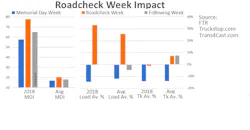
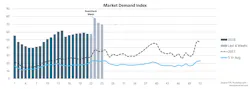
The spot market for Week 23 is the tightest it’s ever been, with the ratio of loads to trucks available spiking at 77.1 to 1 in the Market Demand Index (MDI), reflecting highly pro-carrier conditions, FTR reports.
The previous high was 61.9 in Week 14 of this year.
The five-year average is 23.8 for Week 23 and 17.5 for Week 14, so the current imbalance in the spot market is three times higher than usual.
The MDI measurement of capacity tightness is based on the ratio of loads posted on the Truckstop.com load board vs. the number of trucks with posted availability, with higher numbers indicating a better market for carriers and lower numbers indicative of a pro-shipper environment.
“The market simply is much tighter today,” said Avery Vise, FTR’s vice president of trucking research. “For example, over the last 10 years we have averaged an increase in truck availability of 7 percent after Memorial Day.
“This year we saw a decline of 1 percent.”
Vise said the Commercial Vehicle Safety Alliance’s International Roadcheck is behind the timing of the peak.
The annual Roadcheck is three days of intensive inspections in early June, and specific dates are always announced in advance. In 2017, violations reported to the Federal Motor Carrier Safety Administration’s Motor Carrier Management Information System were 34 percent higher during International Roadcheck week than the weekly average for all of 2017, according to FTR’s analysis.
Barring extreme situations, the MDI peaks each year in Week 22 or 23, during International Roadcheck. Because so many commercial truck drivers take time off that week, shippers must turn to the spot market in unusually large numbers to find trucks to move their freight. So, the spot market gets a double whammy of fewer trucks available and more shippers posting loads at the same time.
Othering finds from analysis:
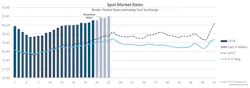
- Record rates – Week 23 broke the record for the highest rates on Truckstop.com’s load board, rising to $2.37, excluding fuel. That rate is 3 percent higher than the previous week – and nearly 25 percent higher year-over-year
- Gains in loads – Posted loads were up 33 percent in Week 23 over the prior week. The average increase was 32 percent during Roadcheck week over the last four years. On an absolute basis, Truckstop.com saw the biggest weekly gain in volumes for a Roadcheck week – increasing by 662,000 posted loads.
- Declines in capacity – The calendar artificially inflates the weekly capacity change because Memorial Day typically reduces capacity by about 14 percent, which FTR saw in Week 22 this year. But FTR also saw the steepest capacity decline for the week after Memorial Day in 10 years tracking the spot market.
“We are seeing a dynamic similar to 2014 when we had a strong freight market combined with a regulatory change that hurt driver productivity,” Vise said.
“Today, that change is the electronic logging device mandate, (and) in 2014 it was changes in the 34-hour restart in hours-of-service regulations – changes that soon were blocked by Congress and ultimately repealed.
“The freight transportation industry is generally well-suited to handling a growing economy. However, when coupled with regulations that impact driver productivity, the increased loads and declining capacity presents major challenges. We expect these challenges to remain throughout 2018.”
About the Author
Related
 adobestock_8264292
 adobestock_340766585