FTR: January Class 8 orders ‘well above’ historic average

North American Class 8 net orders enjoyed a strong year-over-year showing in January, surging ahead of January 2025 by 27%, according to new data from FTR Intel.
The firm’s preliminary tally of 32,500 units was down 24% month-over-month, but y/y growth arrived for the second consecutive month—the first time that has happened since April and May 2024—and orders were well above the 10-year January average of 26,300 units, FTR added.
While the on-highway market made up the bulk of the m/m decline, both on-highway and vocational markets contributed significantly to the y/y increase in orders.
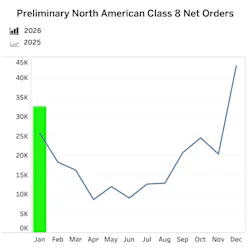
Even with January’s gain, cumulative orders for the 2026 order season from September through January are down 13% y/y, underscoring the notion that recent strength reflects the execution of deferred replacement demand rather than a true demand inflection. Clearer tariff-adjusted pricing and improved regulatory visibility (Classes 3-8 tariffs and EPA 2027 NOx) likely encouraged fleets to move forward with purchases that had been delayed through much of the fall, shifting order activity into late 2025 and early 2026 rather than creating incremental demand.
“Some stabilization and improvement in the freight market since late 2025 also may have provided modest support at the margin, but fleet profitability and capital discipline remain binding constraints,” Dan Moyer, FTR senior analyst for commercial vehicles, said in a news release. “Purchasing behavior continues to be replacement-driven with only modest early EPA 2027 influence. Lingering downside risks include fragile freight fundamentals, elevated cost pressures, geopolitical uncertainty, and broader macroeconomic risk. These risks temper at least some of the enthusiasm around the recent improvement in orders.
“A durable recovery would require notable and sustained y/y order growth as 2026 progresses and meaningful improvement in freight demand, freight pricing, and overall economic conditions.”