DTNA expands engine portfolio for 2027 trucks
Key Highlights
- Daimler Truck North America is expanding its 2027 engine lineup to include Cummins' new B6.7 Octane gasoline engine and redesigned X10 and X15 engines, alongside Detroit’s Gen 6 series.
- The Cummins B6.7 Octane offers diesel-like torque and fuel efficiency, tailored for medium-duty applications, with extended oil change intervals and simplified maintenance.
- The X10 engine replaces older models, providing up to 380 horsepower and utilizing a 48-volt system to meet EPA 2027 emissions standards, supporting cold start emissions control.
- Detroit’s Gen 6 engines feature a redesigned fuel system, improved combustion, and pre-SCR technology to meet stringent NOx emissions requirements while maintaining chassis space.
- These advancements give fleets multiple powertrain options aligned with duty cycles, operational goals, and long-term sustainability, ensuring compliance and performance for future trucking needs.
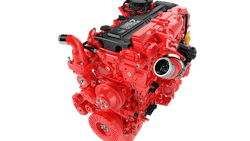
Daimler Truck North America is expanding its power train portfolio for upcoming 2027 products, adding new Cummins engines alongside Detroit’s Gen 6 diesel lineup across Freightliner and Western Star models.
These additional offerings from Cummins complete the 2027 engine lineup and include the new B6.7 Octane gasoline engine, the clean-sheet X10, and a redesigned X15, DTNA reported. Together, the Detroit and Cummins engines are designed to meet upcoming emissions requirements across a variety of applications.
“Cummins is a critical partner for DTNA, and integrating their engines ensures our portfolio covers the full spectrum of applications for our customers,” Joanna Buttler, DTNA general manager of product strategy and market development, said in a news release. “Their next generation of engines strengthens the range of powertrain solutions available across Freightliner and Western Star, and support customers as they prepare for upcoming emissions requirements and long-term operational needs.”
Cummins B6.7 Octane: New MD gasoline engine
The new Cummins B6.7 Octane, the company’s first purpose-built, commercial-grade gasoline engine, is designed specifically for medium‑duty applications and available in the Freightliner M2 106. The engine delivers up to 300 horsepower and 660 lb.‑ft. of torque, offering performance characteristics traditionally associated with diesel engines while using readily available 87‑octane gasoline.
According to Cummins, the B6.7 Octane leverages Cummins' HELM platform architecture, which allows different combustion systems to share a common engine platform, and offers:
- Diesel‑like torque response for demanding duty cycles such as hilly terrain and cold environments.
- A simple three‑way catalyst eliminates DEF, active regens, and diesel aftertreatment hardware.
- Fuel efficiency up to 10% better than comparable gasoline engines.
- Extended oil-service intervals of up to 15,000 miles contribute to lower operating costs.
“The B6.7 Octane provides fleets a commercial grade gasoline solution built for tough duty cycles without increasing maintenance demands,” said Jim Nebergall, Cummins executive director for product and market strategy. “It leverages our established B Series platform to maintain familiar service practices. By combining diesel-like durability with gasoline simplicity, the B6.7 Octane offers customers dependable performance in a footprint they already trust.”
The B6.7 Octane fills a gap for fleets that want the simplicity of gasoline operation without sacrificing the torque response required in vocational, pickup‑and‑delivery, and urban applications.
Ordering for the B6.7 Octane is now open, and start of production is scheduled to begin in the third quarter of 2026.
Other Cummins 2027 engines: New platforms, proven carryover
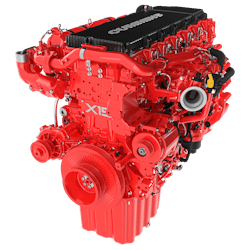
The X10 and X15 engines represent new developments built on decades of market experience, and both will be offered across a range of Freightliner and Western Star products, DTNA said. The Cummins X10 is a clean‑sheet design engineered to replace both the L9 and X12 engines. It delivers up to 380 horsepower for medium‑duty applications and up to 450 horsepower in heavy‑duty applications. This engine uses a 48-volt electrical system to heat emissions-control components quickly during cold starts, reducing emissions and supporting compliance with EPA 2027 requirements.
Several established Cummins platforms will continue into the 2027 lineup and will be available across a range of Freightliner and Western Star trucks, maintaining their longstanding role in medium- and heavy-duty applications:
- B6.7 (diesel): Long‑established medium‑duty workhorse
- L9N (natural gas): Reduced‑emissions solution with simplified aftertreatment
- X15N (natural gas): Heavy‑duty and long‑haul option with renewable‑fuel capability
Together, these engines give fleets multiple pathways to align their powertrain choice with duty‑cycle needs, fleet strategy, and long‑term operating goals.
Detroit’s Gen 6 engine platform
In February, DTNA revealed its updated Detroit Gen 6 engines, to include the DD13, DD15, and DD16. Built on a platform with more than 1.2 million engines in service, these engines refine the previous generation’s design, providing confidence that the durability and reliability that Detroit is known for continue.
The Gen 6 engines deliver enhanced efficiency designed to help offset the impacts from emissions-related changes, DTNA reported. Key updates include a redesigned and simplified fuel system that removes the need for amplified injection and supplies higher, stronger and more consistent fuel flow. Similarly, the addition of an asymmetric intake port increases swirl, and, combined with new fuel injectors, improves fuel and air mixing for a more complete combustion. The use of Miller timing on the camshaft reduces the work of compression, increases the compression ratio and contributes to overall engine efficiency.
To meet compliance with stringent NOx requirements included in EPA’s 2027 standards, Detroit Gen 6 engines use a pre-Selective Catalytic Reduction (pre-SCR) system, positioned upstream of the primary aftertreatment system (ATS). This technology, combined with a thermal control valve, helps the ATS to reach operating temperature more quickly, reducing the need for parked regens. The ATS design preserves existing chassis space with no impact to back-of-cab packaging, a key advantage for vocational customers and truck equipment manufacturers.
The Detroit Gen 6 DD13 and DD15 engines will be available beginning in January 2027, with Gen 6 DD16 production following in January 2028.