Reports: Trade policies, soft demand burden trailer activity
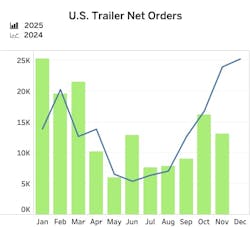
U.S. trailer order intake receded in November after enjoying a seasonal spike the previous month, according to the latest reports from FTR Intel and ACT Research.
FTR observed a 19% month-over-month in decline in order activity, with fleets logging only 13,071 orders in November in a 45% year-over-year plunge that highlights the “fragility of demand.” Order volumes remain well below historical norms, the firm added, with pressure coming from tariff-driven trailer cost increases, soft freight demand, tight margins, and limited confidence in near-term rate recovery. The sharp year-over-year drop suggests fleets are deferring discretionary replacements deeper into 2026—and possibly 2027. Growth-oriented ordering is unlikely until freight fundamentals and fleet profitability materially improve.
“The U.S. trailer market is increasingly constrained by trade policy, elevated input costs, and cautious fleet behavior,” Dan Moyer, FTR senior analyst for commercial vehicles, said in a news release. “Policy-related actions are now a central driver of both cost inflation and demand uncertainty. Limited visibility on trade outcomes continues to complicate pricing, sourcing, and capital allocation decisions across the industry.
“Section 232 tariffs remain the industry’s most significant and durable cost headwind, and trade risk is also building around van trailers. A U.S. International Trade Commission antidumping and countervailing-duty investigation into van trailers and subassemblies imported from Canada, China, and Mexico adds further uncertainty for cross-border supply chains and pricing dynamics in the high-volume van segment.”
For 2025 to date, net trailer orders total 148,862 units, up 7% y/y, FTR said. However, as previously noted, part of 2025’s y/y gain results from demand early in the year that normally would have occurred in 2024 as many fleets held off until after the November election. A more meaningful comparison period is the 2026 order season. September-November 2025 orders are down a concerning 28% y/y.
OEMs trim trailer backlogs
U.S. trailer production finally pulled back in November, FTR continued.
Builds dropped 23% m/m—or roughly twice the typical seasonal decline—and edged 1% lower y/y to 13,533 units. Despite the pullback, production continues to run ahead of demand as OEMs manage labor levels, fixed-cost absorption, and year-end capacity utilization. As a result, backlogs were down 1% m/m and 23% y/y to 72,697 units, but the backlog/build ratio improved to 5.4 months due to the larger m/m drop in production than in orders.
Additional production cuts likely will be needed to prevent further backlog erosion unless the 2026 order season improves meaningfully.
“Overall, tariffs and expanding trade actions are locking in higher costs and sustained uncertainty across the U.S. trailer market,” Moyer concluded. “OEMs and suppliers likely will respond by prioritizing localized sourcing, tariff-aware design, and flexible pricing. Dealers must manage inventory carefully and set clear expectations as higher price floors constrain demand.
“For fleets, rising acquisition costs and policy risk favor selective ordering, longer trade cycles, and a sharper focus on total cost of ownership.”
Purchasing spigot still clogged
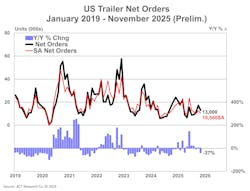
ACT reported November net trailer orders of 13,000 units, which is down 4,100 trailers from October in a 24% m/m slide and 37% y/y decline. Seasonal adjustment at this point in the order cycle lowers the monthly tally to about 10,500 units, ACT added.
“Sequentially, a slight dip in net orders is expected, as October is usually the strongest order intake month of the annual cycle, with order boards for the next year beginning to open,” said Jennifer McNealy, ACT director of CV market research and publications. “November’s tally brings the year-to-date net order total to 151,300 units, or 9% more net orders than were accepted through year-to-date November 2024.
“Not only do net orders continue to underwhelm, cancellations remain elevated. Looking forward, concerns about moderating economic activity, ongoing weak for-hire carrier profitability, and ambiguous government policies remain as challenges to stronger trailer demand. While pent-up demand is building, and fleets will eventually need to divert capex to trailing equipment purchases deferred over the past few years, stronger revenues will be needed before the purchase spigot is opened wider.”