Reports: US trailer orders surge as market rebounds
Key Highlights
- U.S. heavy-duty trailer orders in August exceeded 24,100 units, marking a 55% increase from July and a 193% rise year-over-year.
- Analysts attribute the surge to pre-tariff ordering, improved freight rates, and pent-up replacement demand amid a recovering market environment.
- Despite strong order growth, some fleets remain cautious due to higher maintenance costs and lingering policy uncertainties affecting equipment costs.
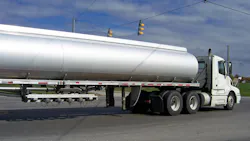
U.S. heavy-duty trailer orders surged past 24,100 units in August, marking a dramatic late-summer rebound fueled by pent-up demand and looming tariff-driven price hikes.
Market analyses from commercial vehicle research firms ACT Research and FTR Intel show preliminary net orders jumping between 43% and 55% over July’s totals. This sharp sequential increase pushed August volumes to more than double the orders recorded during the same period in 2025.
Both firms attribute the steep year-over-year gains partly to comparisons against an unusually weak 2025 environment. However, analysts agree that underlying market fundamentals are finally turning positive, with tight capacity and recovering carrier profitability encouraging fleets to secure equipment as they transition toward the 2027 order cycle.
ACT: Atypical gain signals turning tide
According to preliminary data from ACT, U.S. net trailer orders reached 24,200 units in August, up roughly 8,600 units (55%) from July and 193% higher than August 2025. On a seasonally adjusted basis, orders totaled 33,700 units, making August the second-highest seasonally adjusted order month in the past 43 months.
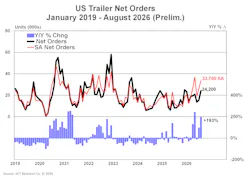
“Seasonally speaking, August net orders should have improved sequentially, so the uptick from July was no surprise,” Jennifer McNealy, ACT director of CV market research and publications, said in a news release. “The degree of improvement, however, by historical standards was atypical. Typically, July is the weakest net-order month of the annual ordering cycle, as fleets have made their decisions for current-year needs and OEMs start to build down the backlog.
“That said, this year’s cycle has been anything but ordinary. The order cycle that should have started about this time last year was delayed due to ongoing weakness in freight rates and policy-driven uncertainty. With freight rates and carrier profits on the mend, August orders are on track to be the best since last December and the second best in the past 30 months.”
ACT noted that while orderboards opened early amid relatively few remaining 2026 build slots, caution remains a strategy for some purchasers due to lingering challenges from higher maintenance costs and downtime. Nevertheless, the firm identified a three-fold driver behind the unseasonable spike: customers ordering ahead of tariff-related price increases, healthier long-term business conditions, and pent-up replacement demand.
FTR: Orders surge despite mounting pressures
FTR reported U.S. net trailer orders of 24,144 units for August, representing a 43% month-over-month surge and a 221% increase year-over-year. The August figures closed out the 2026 trailer order season (September 2025 to August 2026) at 212,116 units, up 13% compared to the prior season.
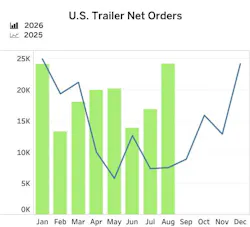
Year-to-date net orders reached 150,320 units (up 38% year-over-year), while year-to-date trailer production dipped 1% year-over-year to 130,922 units despite August builds rising 5% sequentially to 16,953 units.
“The stronger order performance is encouraging, but the recovery remains uneven by segment,” said Dan Moyer, FTR’s senior analyst for commercial vehicles. “Fleets appear more willing to address replacement needs, while elevated equipment costs and competing capital requirements continue to keep spending selective.”
FTR indicated trade policy is becoming a larger factor in the equipment cost equation for U.S. trailer manufacturers and importers. Recent cost pressures stem from the reconfiguration of steel and aluminum tariffs in April, antidumping and countervailing duty investigations regarding van-type trailers, and retaliatory tariffs by Canada that include trailers.
As the Class 8 truck pre-buy concludes, FTR expects a greater portion of fleet capital to shift toward trailer replacement and modest fleet growth.
About the Author
 Jason McDaniel
Jason McDaniel
Jason McDaniel, based in the Houston TX area, has more than 20 years of experience as an award-winning journalist. He spent 15 writing and editing for daily newspapers, including the Houston Chronicle, and began covering the commercial vehicle industry in 2018. He was named editor of Bulk Transporter and Refrigerated Transporter magazines in July 2020.