Fish tale: West-Mark tanks transport 130,000 live salmon
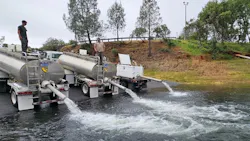
The California Department of Fish and Wildlife (CDFW) recently used two West-Mark tanks to restock Lake Oroville with 130,000 Chinook salmon fingerlings.
CDFW crews transported the live fish, all ranging from 4 to 6 inches long, 9 miles from the Feather River Fish Hatchery to the Loafer Creek Boat Ramp on Lake Oroville using specialized West-Mark transport equipment, including a “FishTrucka” tank wagon and a “FishTLR-Ta” tandem-axle trailer.
“For decades, our team [in Atwater, California] has engineered the specialized fish transport tankers that move living payloads across California’s hatchery and stocking network,” West-Mark said in a blog post. “The fingerlings stocked into Oroville [in April] are triploid—sterile—meaning they exist specifically to build out recreational fishing opportunities without risking genetic impact on wild populations. That makes the stocking program valuable. But it also means every fish lost in transit is a fish that can never be replaced through natural reproduction.
“The stakes explain the engineering. Dissolved oxygen, water temperature, ammonia buildup, and mechanical stress during transit are all variables that can turn a conservation release into a total loss inside of minutes. West-Mark’s fish transport platforms are not retrofitted water trucks. They are rolling life-support ecosystems—purpose-built, instrumented, and insulated—designed to hold water chemistry stable mile after mile through the Central Valley heat.”
Lake Oroville is California’s largest state reservoir, serving 27 million residents. It also supplies water back to the Feather River Fish Hatchery, so every fish entering the lake has to be certified disease-free. CDFW rigorously tests every release for pathogens like Infectious Hematopoietic Necrosis (IHN) before a single tanker rolls, West-Mark reported.
A Fox40 news crew covered the release, and the news station posted the story online, drawing praise from California’s conservation and angling communities “in force” and the “good-natured humor you only get from a region that knows what’s rolling down the highway in those tankers,” West-Mark said.
About the Author
 Jason McDaniel
Jason McDaniel
Jason McDaniel, based in the Houston TX area, has more than 20 years of experience as an award-winning journalist. He spent 15 writing and editing for daily newspapers, including the Houston Chronicle, and began covering the commercial vehicle industry in 2018. He was named editor of Bulk Transporter and Refrigerated Transporter magazines in July 2020.